How the work is made
Cuerda
Seca
Dry cord. A ninth-century answer to the oldest problem in glazing: how to stop one colour running into the next.
Every mural on this site is drawn before it is fired. The drawing is the work; the clay is how it survives a hundred years of weather. What follows is the whole sequence — from the first research trip to the last tile set on the wall.
- Technique
- Cuerda seca
- Meaning
- “Dry cord,” from the Spanish
- Origin
- Persia, 9th–10th century
- In California
- By the early 1800s, via Spain
- Body
- Terra cotta
- Palette
- A painted sheet of forty glazes
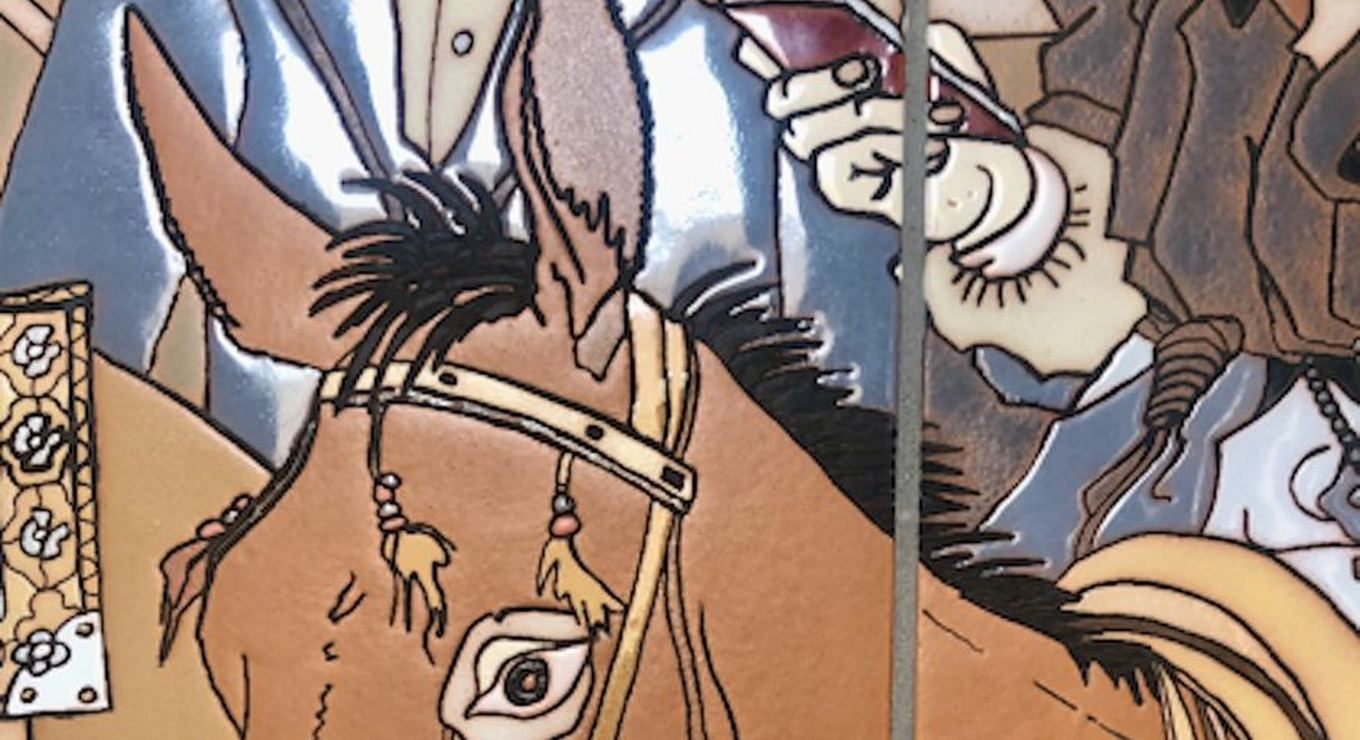
What it is
A line of bare clay, doing the work of a lead came
Glaze is glass suspended in liquid. Put two colours next to each other on a flat tile, fire them, and they meet in the middle as a third colour nobody chose. Every tradition that wanted drawn imagery in ceramic had to solve this, and cuerda seca is the oldest solution still in daily use.
The drawn line is printed onto the raw clay in a greasy resist — historically manganese and linseed oil, hence the “cord.” Glaze will not sit on it. In the kiln the resist burns away and leaves a narrow band of bare terra cotta standing slightly proud, with a pool of glass held on either side.
The result behaves like a stained-glass window: saturated fields of colour separated by a dark outline, each colour deep enough to read from across a lobby. The difference is that a window needs light behind it, and this does not.
Where it comes from
Persia to Ventura, by way of Spain
The technique appears in Persia in the ninth and tenth centuries and travels west with Islamic architecture into Spain, where it covers palace walls, courtyards and fountains for the better part of a thousand years. It crosses the Atlantic with the Spanish and reaches California by the early 1800s — which is why it reads as native here rather than imported.
By the 1920s it had become the language of California tile: Spanish Revival building facades, the courtyards of Santa Barbara, and above all the short, brilliant life of Malibu Potteries, whose work survives at the Adamson House. Anyone who has admired a Californian tiled doorway has been looking at a Persian technique, filtered through Andalusia, carried by missionaries and revived by the 1920s building boom.
What it offers a building has not changed in eleven hundred years: colour that does not fade, a surface that washes clean, and a drawn line that will still be legible when the mortar around it has been repointed twice.
The sequence
Seven stages, and only one of them is ceramic
From first conversation to last tile, a mural of any size follows the same order. The clay comes in late.
-
The conversation
Every commission begins with the building and the people in it — what the wall is for, who walks past it, what the client would want a stranger to understand about the place. On more than one job the client’s own life has ended up in the tile: a dog, a boat named for a wife, a novel.
-
Research
Where the subject is historical, the research is real and it is slow. The Ventura history murals took weeks in the Museum of Ventura County library, checking saddles, canoes, period clothing and building dates against the record before a line was drawn.
It is the part nobody sees and the part that holds up under questioning — which, at an unveiling with the local historical society in the room, matters.
-
The scaled design
A measured elevation, drawn to scale and annotated, so the client and the architect can see exactly what will be built and where every element sits. This is the drawing that gets approved.
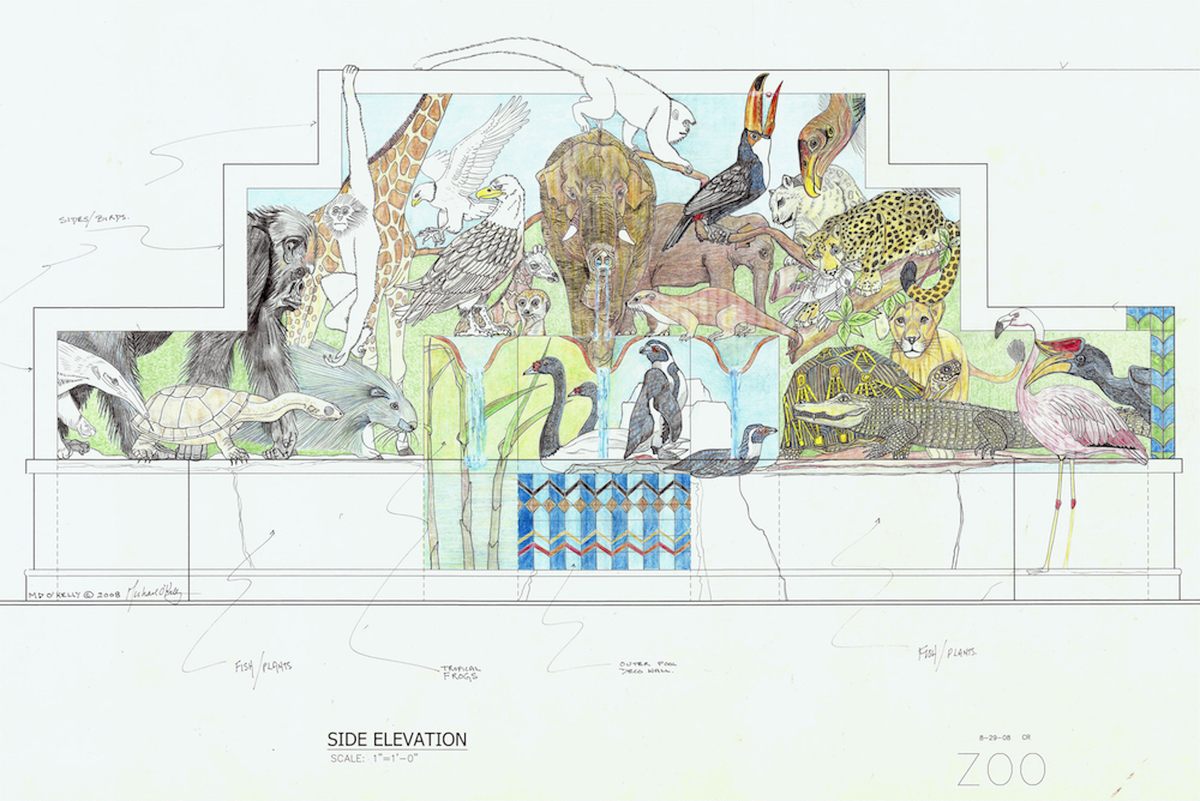
Side elevation, 1 inch to 1 foot. The approved design for the Animal Kingdom Fountain, annotated in the margins — fish / plants, tropical frogs — and signed by the artist. -
The full-size cartoon
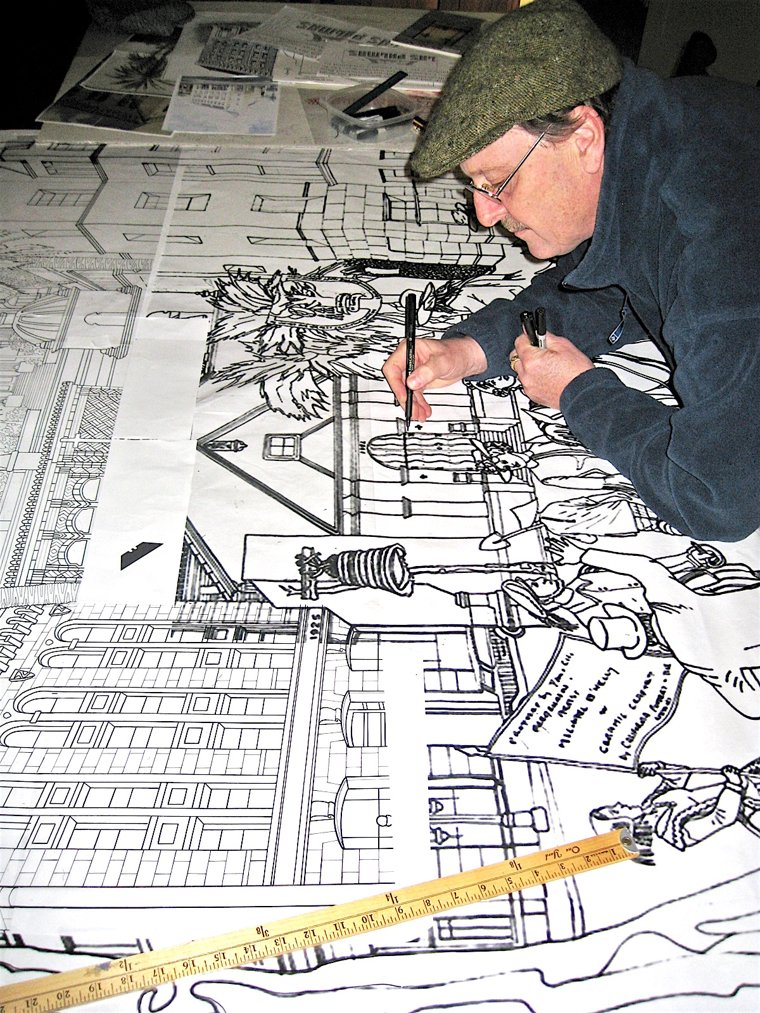
The whole composition is then drawn by hand in pen and ink and enlarged to the mural’s exact finished size. Fifty feet of wall means fifty feet of drawing, laid out on tables and worked on from above.
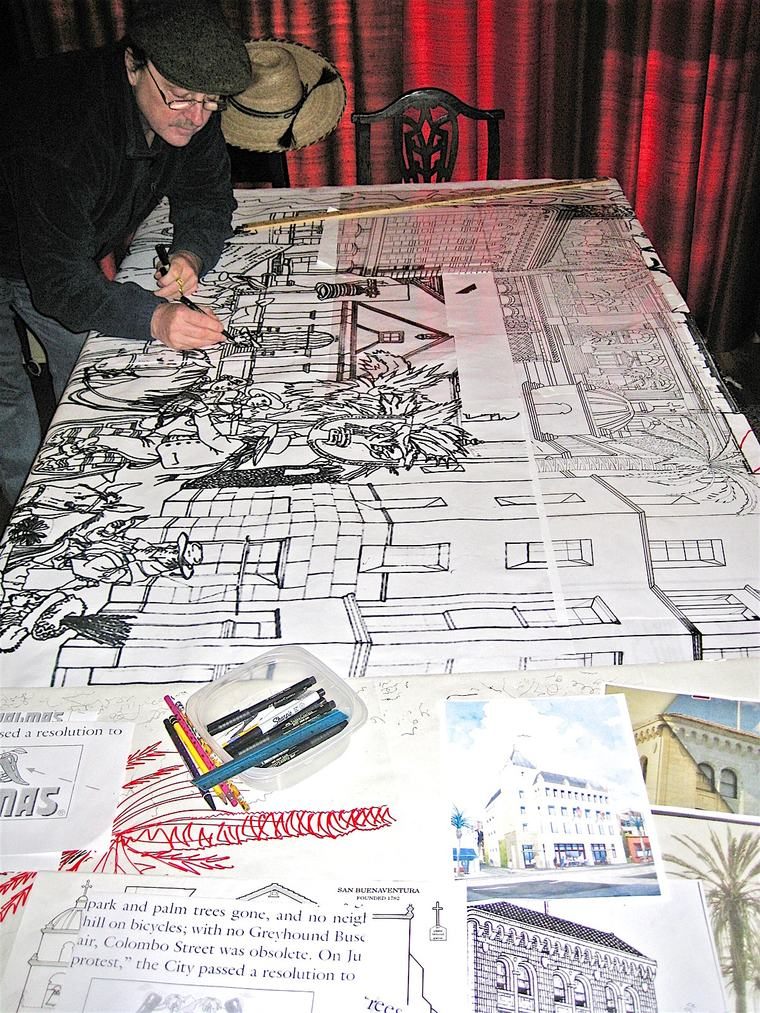
Inking a full-size cartoon in the studio, surrounded by the archive photographs the drawing is built from. -
Traced, screened, printed
The cartoon is traced onto acetate and separated into tile-sized units. A silk screen is burned from the acetate, and the line is printed in resist directly onto the raw terra cotta — not onto paper, onto the clay itself.
“I burned a silk screen, like making a T-shirt, onto the actual terra cotta.”
-
Glazing, to a sheet of forty colours
The printed tiles go to the glazers with a painted colour sheet to follow — forty glazes, numbered, each laid inside its own resist line by hand. It is closer to painting by number than anyone expects, and it is the only way a wall of several thousand tiles comes out of the kiln looking like one drawing.
-
Fired, then set
Firing burns the resist away, vitrifies the glaze and fixes the colour for good. Then the tiles are set on the wall one at a time, by the artist — because a mural that has been drawn as a single image has to be hung as one too, and the last adjustments happen with the tile in hand.
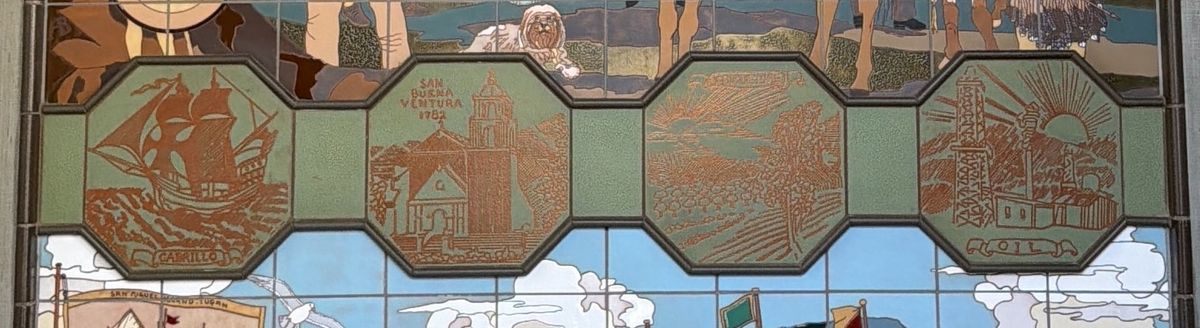
Finished and set: modelled relief medallions, where the drawn line becomes an actual raised edge in the clay.
Twenty-two colours sampled from a finished wall — the glazers work to a painted sheet of forty
For the building
Why an architect specifies this rather than paint
It does not fade
The colour is glass, fired into the body. Ultraviolet does nothing to it. A painted mural on a west elevation is a maintenance line item; this is not.
It washes
A vitrified surface takes soap and water, and takes graffiti removal without losing its drawing. Twenty years of street frontage leaves no mark.
It reads at distance and up close
Bounded fields of saturated colour carry across a plaza; the drawn line rewards standing a foot away. Few surfaces do both.
It is repairable
Tiles are discrete. A damaged one can be redrawn, reglazed and reset without touching its neighbours — which cannot be said of a painted wall.
It suits the vernacular
On a Spanish Revival or Deco elevation in California, this is not a foreign object. It is the material the style was built with.
It is made to the building
Nothing is bought in. The drawing is made for that wall, at that size, with that building’s own history in it.
The same idea, on metal
Dye sublimation: paintings baked into aluminium
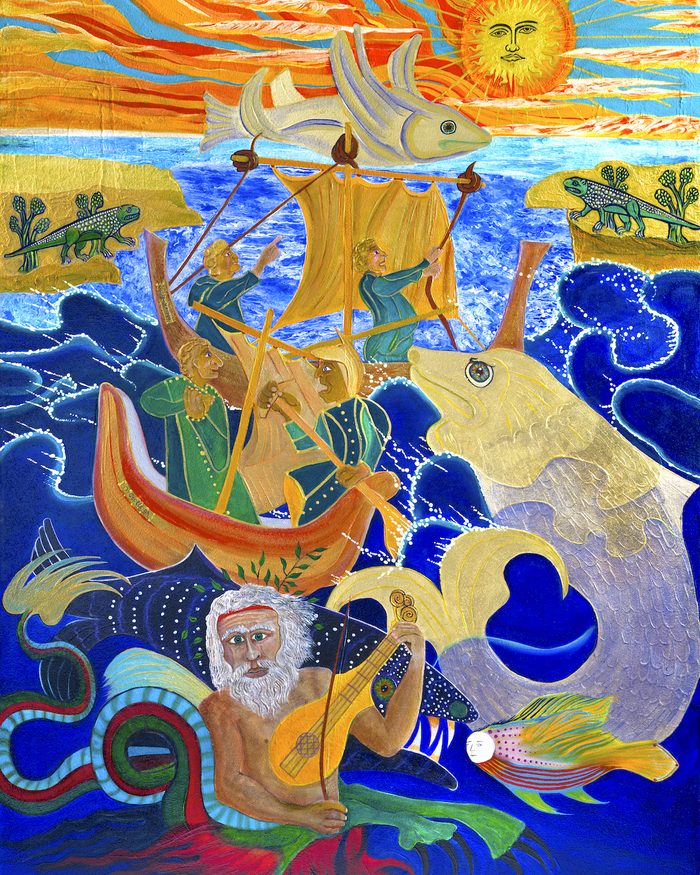
Michael’s recent paintings are made to be finished as dye sublimations on aluminium. Heat and pressure turn the inks into a gas, which melds into a coated aluminium panel. Nothing sits on top of the surface to scratch or peel.
“The image is not printed on the metal. The metal is turned into the image, baked onto the substrate like high-fired glazes on ceramic.”
Michael O’Kelly
It is the same principle as the tile: colour fixed by heat, so it lasts. The panels are light, can hang outdoors or in bright rooms, and keep the full detail of the original drawing and paint — the reason the Fine Art collection can be seen here in deep zoom. See the paintings →
See it
The technique, in three walls
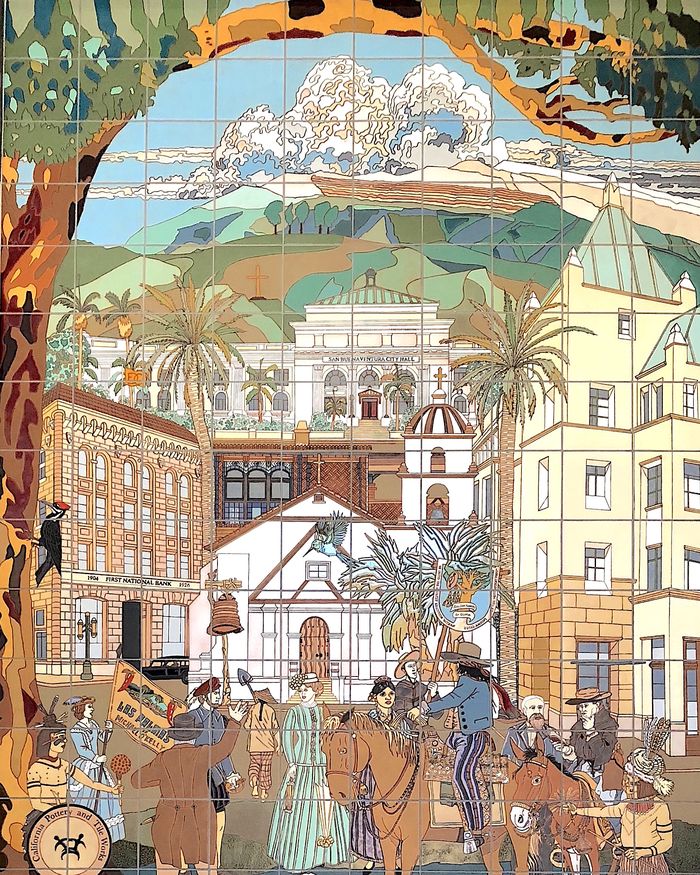
Las Palmas
Two centuries of a town, with a deep-zoom viewer that gets close enough to see the resist lines.
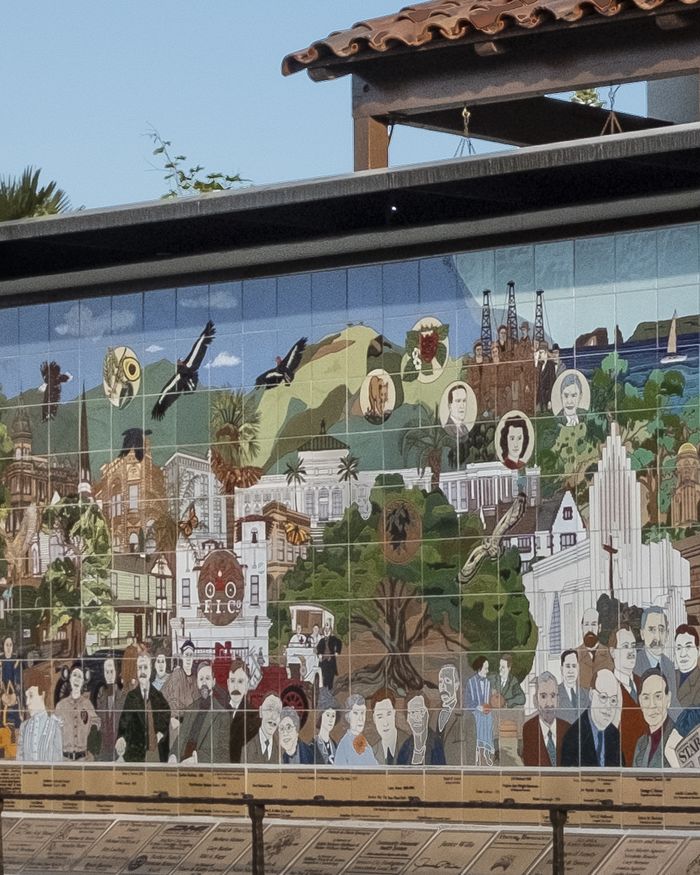
Ventura Historic Mural
Fifty feet, and the largest single run of this technique in the county.
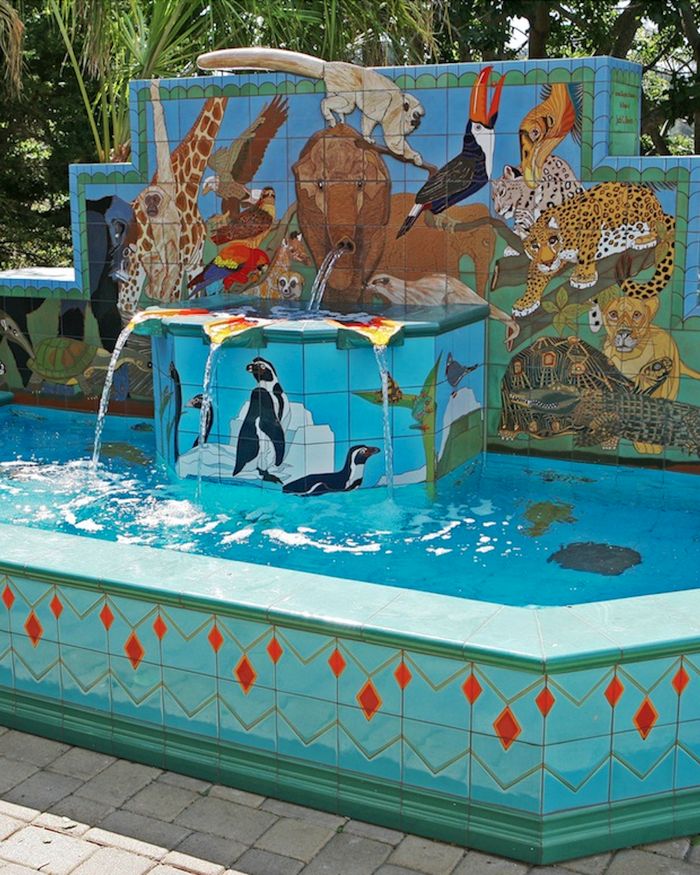
Animal Kingdom Fountain
The same technique underwater — where the glaze has to survive chlorine as well as sun.
Commissions
Commission a mural for your building
Residential, civic and commercial work throughout California, from the first conversation to the last tile set on the wall.