Ceramic tile mural · San Buenaventura Mission, Ventura · 2018
Ventura Historic Mural
A hundred and fifty years of a city, told face by face beside the Mission
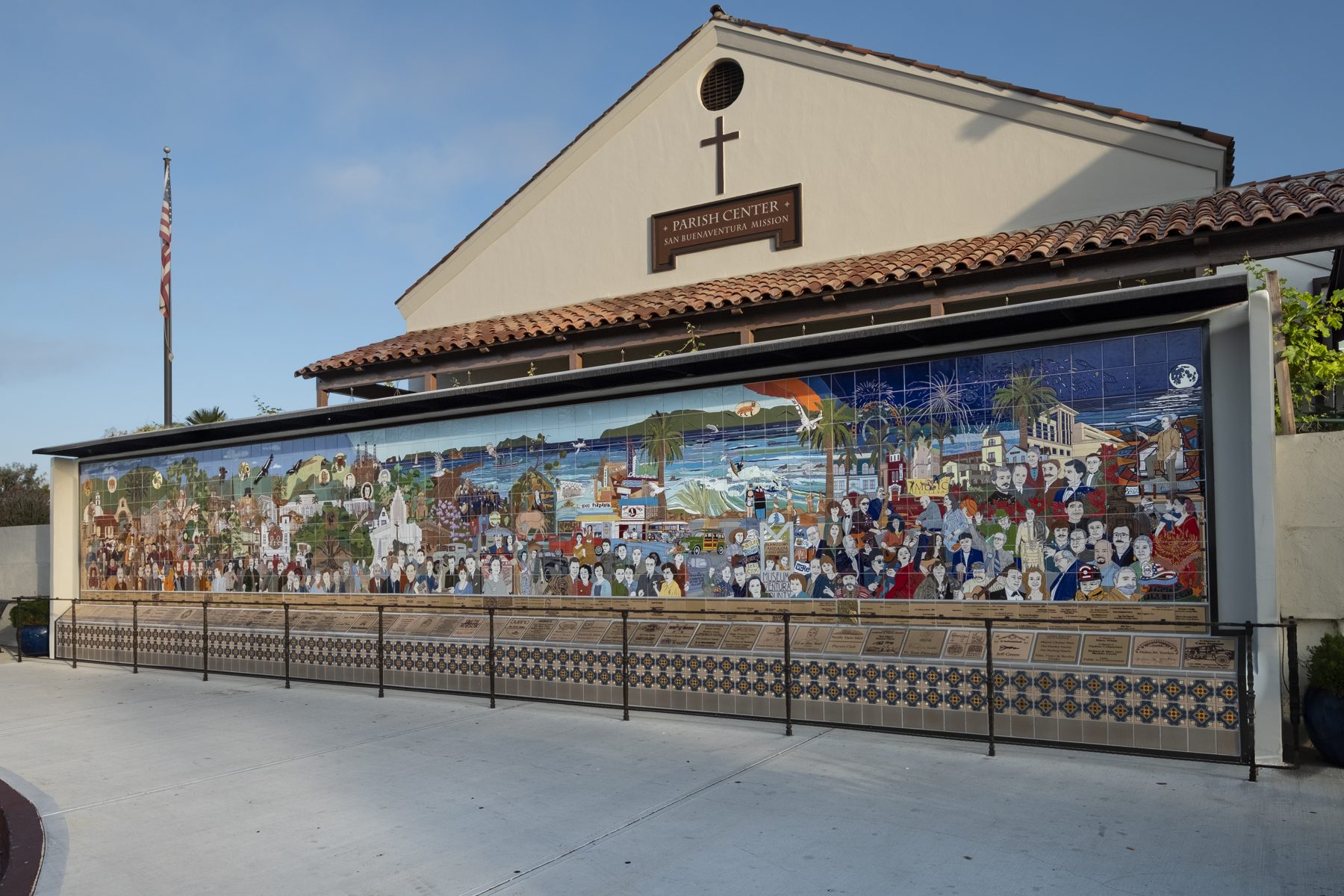
For Ventura’s 150th birthday, Michael O’Kelly drew the whole town — founders and firemen, surfers and musicians, a pizza-maker’s father — fifty feet long and one face at a time, then set it in tile on Main Street, beside the Mission where the city began.

How to look closely
- Drag or scroll sideways along the strip to walk the wall from 1866 to 2017.
- Walk the wall opens it full-screen at full resolution. Scroll or pinch to zoom, drag to move.
- Further down, find the six butterflies Michael used to hide his mistakes.
- Esc closes the viewer.
- Installed
- January 2018
- Medium
- Hand-glazed ceramic tile
- Technique
- Cuerda seca, with metallic glazes
- Dimensions
- 50 ft long × 9 ft high
- Occasion
- Ventura’s 150th anniversary, 1866–2016
- Historian
- Cynthia Thompson
- Funded by
- Private sponsors
- Made with
- Juan Aguierre, master ceramicist
- Location
- San Buenaventura Mission, Main Street
- Access
- Outdoors, free, any time
Film
Michael at the wall
Six short chapters from a walk along the mural with the artist, in his own words. Pick one, or let them play through.
Ventura Historic Mural · 2018
Michael O’Kelly
michaelokelly.com
Subtitles are lightly edited from an automatic transcript and still to be checked by Michael.
Read the transcript
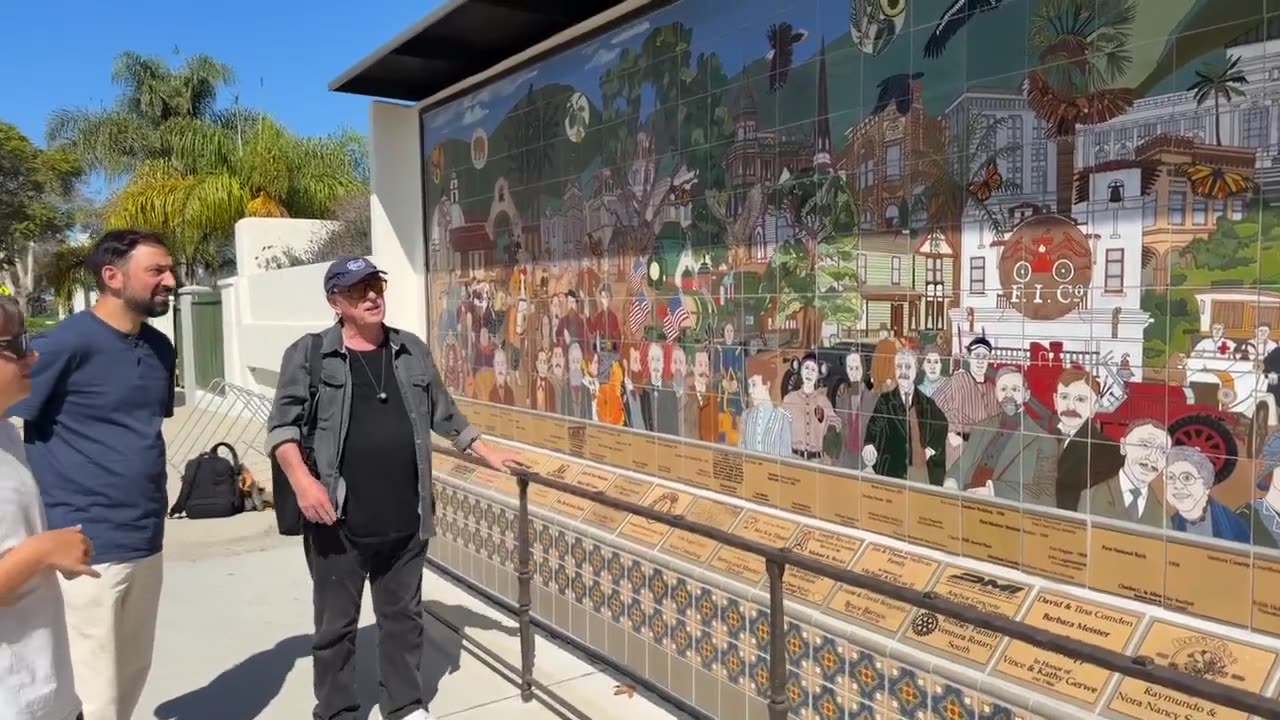
A historian’s spreadsheet“And this row of tile plaques here represents the people who sponsored it — who funded the whole thing. This woman here, for example, is a very well-known historian, Cynthia Thompson, and she made me a spreadsheet. We had all of this in writing: location, buildings, people, time — and I followed that spreadsheet and started to draw. The drawing for this is 25 feet long. This is 50 feet long. It took a year. A very slow process of picking the people, getting imagery from the museum and from books, of what they looked like, and trying to represent them one person at a time, trying to fit them in, and make a composition that makes sense as a work of art as well as a story.”
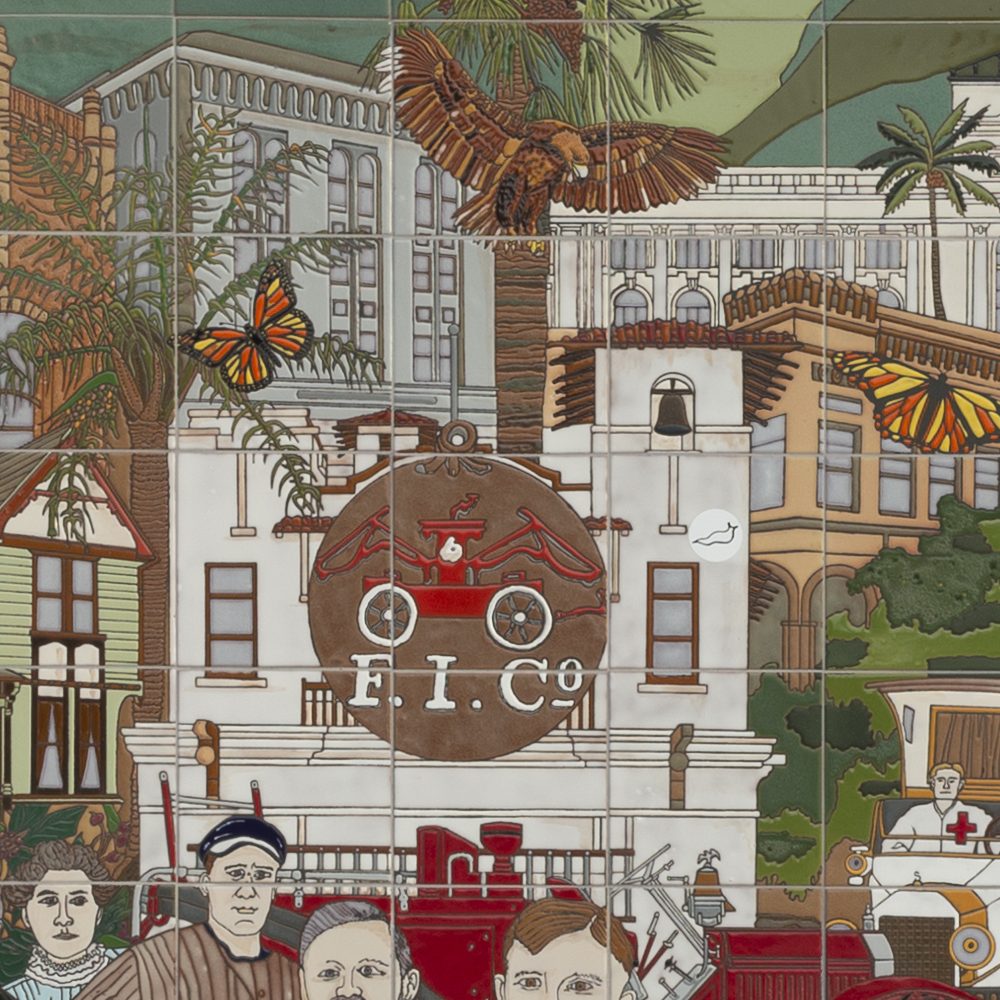
The butterfly secret“If you want to hear something you might find funny — You see these monarch butterflies here? The reason they’re in those locations is that I made a mistake on the drawing. In all those spots they didn’t want to redo it, so I put a butterfly over the mistake. I’m telling my secrets, man.”
Building a wall to last“In the building next to the Mission, we would bring the tiles as they were made and lay them out. Some of the tiles got broken, so we had to redo those. The installation took about three months. You have to be very careful. The wall has to be made absolutely flat — reinforced more than most walls. Every block has rebar in it, and it goes down about six or seven feet, so it won’t move. If it moves in an earthquake, the whole thing moves. We had a team of construction guys — they were great — and we redid the whole sidewalk too. Then there were just four of us putting it up. We built a canopy over it so we could survive the sun. It was hard work.”
A thousand-year tile“The beauty of this is: whatever the weather, the tile we make will last a thousand years. If you go to Spain or Portugal, there are tile murals that have lasted 1,300 years. It’s the cuerda seca technique. You make the drawing — see the outline here? — with an oil-based wax, which is what they used back then. To make the tile, everything has to be a compartment. The teeth are a compartment, the hair’s a compartment, and this colour can’t go past that line. The line creates a dam. Everywhere you see the black line, it contains the glaze, and when it’s fired — it kind of mounds and makes a beautiful texture. It’s almost three-dimensional. It makes people feel good. It’s like having an artifact. An archaeologist could dig this up a thousand years from now, and it would still be like this. It’s fired at 2,150 degrees.”
The town’s own faces“All these people — they’re wonderful people who sponsored it. They were so generous. A lot of these people are alive and well today, and they love this thing. There’s a place called Tony’s Pizzeria down the street. He came here and started to cry when he saw it, because his dad’s on it. He was in the Second World War. A lot of people alive today have relatives here who have passed on, so it has an emotional connection to the people of the town.”
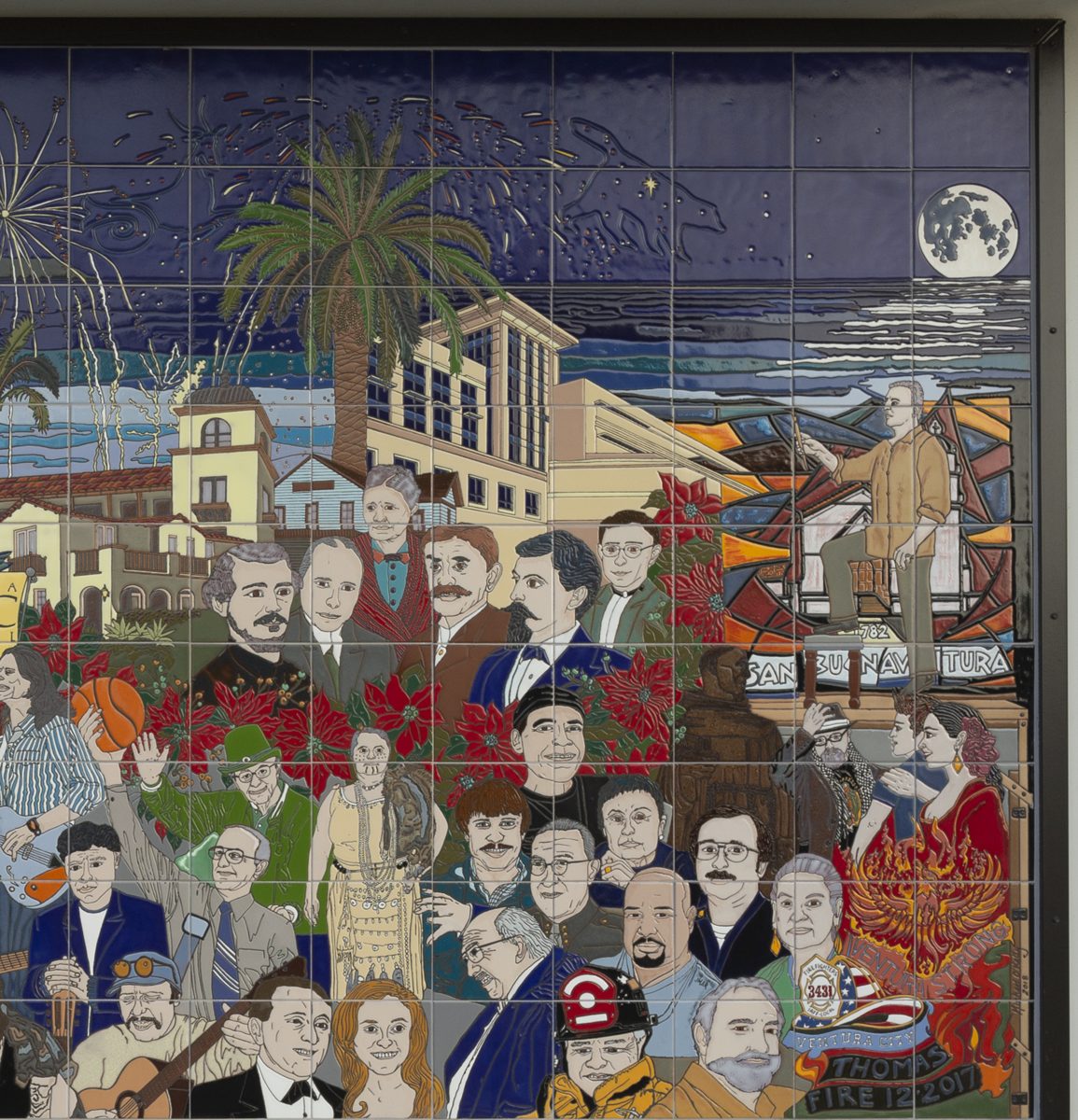
The ending he redrew“I changed the ending of the mural because of the Thomas Fire. I had about five feet already designed, and when the Thomas Fire hit, we had to change the whole ending. It could have burnt the town down. The town was saved by the firemen — and one of them died, so we put a memorial plaque there for Cory Iverson. This last part is new. I had to quickly redesign it, redraw it and make the ending: Ventura Strong. Thomas Fire, 2017. And the phoenix rising from the ashes. The fire department came to my studio to thank us. They were really moved that we honoured them.”
Michael O’Kelly, at the wall, September 2026. Lightly edited from an automatic transcript; to be checked by Michael.
Find it in the mural
The butterfly hunt
“The reason they’re in those locations is that I made a mistake on the drawing,” Michael says. “So I put a butterfly over the mistake. I’m telling my secrets.” Six monarchs hide six mistakes. Drag along the wall and tap each one you find.
Five more things to find
Each one opens the wall at full magnification.
A painter at each end
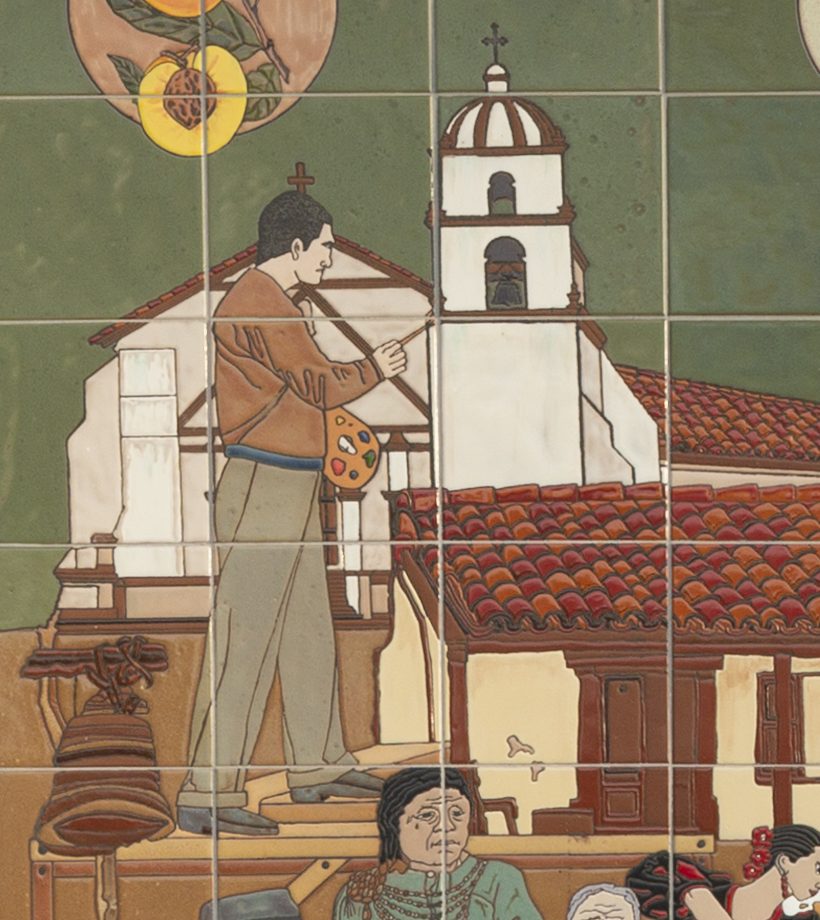
The wall opens with an artist on a scaffold painting the Mission — and closes with another painting “San Buenaventura 1782”.
The first fire engine
The first firehouse and its first engine, marked F.I.Co. The building still stands, remodelled.
The Star
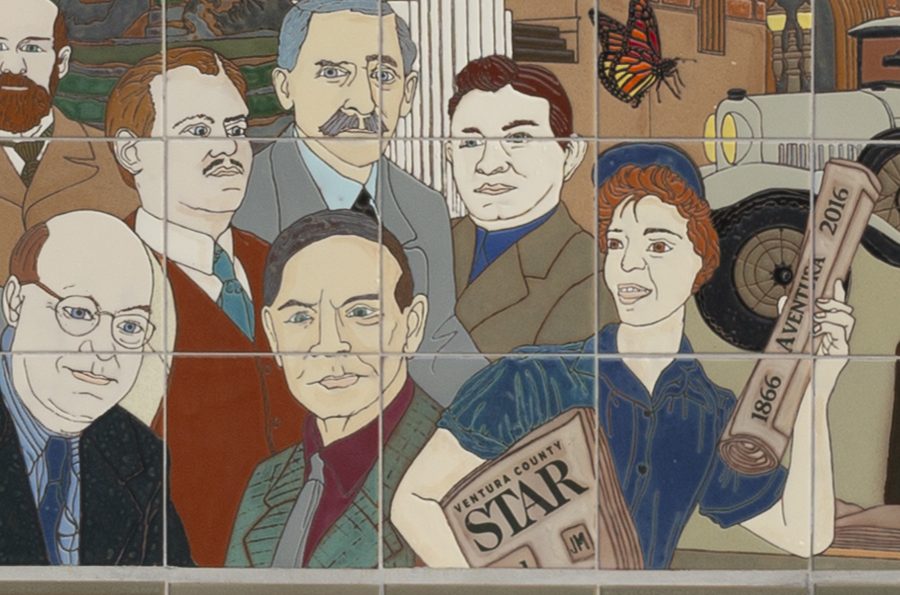
The Ventura County Star was one of the sponsors. Look for the paper held up in the crowd, and the rolled one reading 1866–2016.
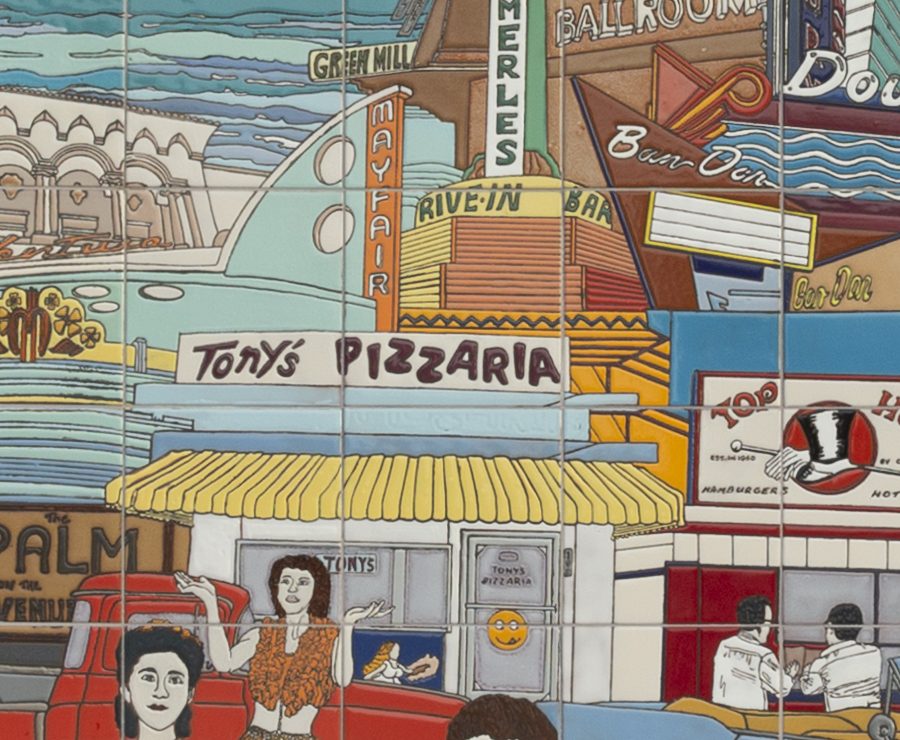
Tony’s Pizzaria
When the owner saw the mural, he cried: his father, who served in the Second World War, is on the wall.
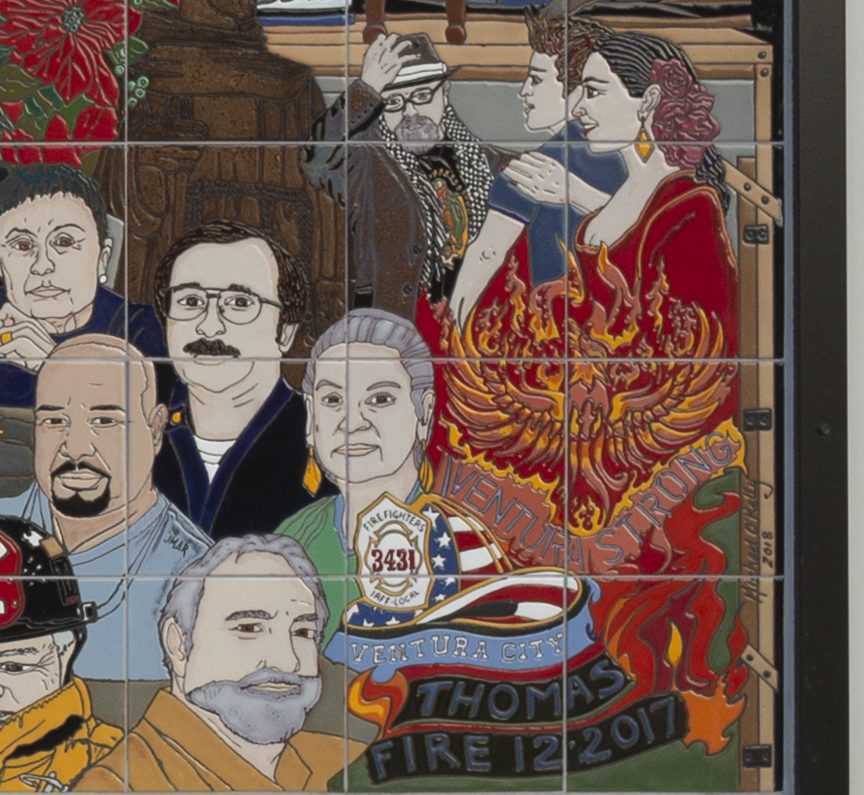
The phoenix
The last thing on the wall: a phoenix, “Ventura Strong” and “Thomas Fire 12·2017”.
Reading the wall
Left to right, 1866 to 2017
Where it begins
Where it begins
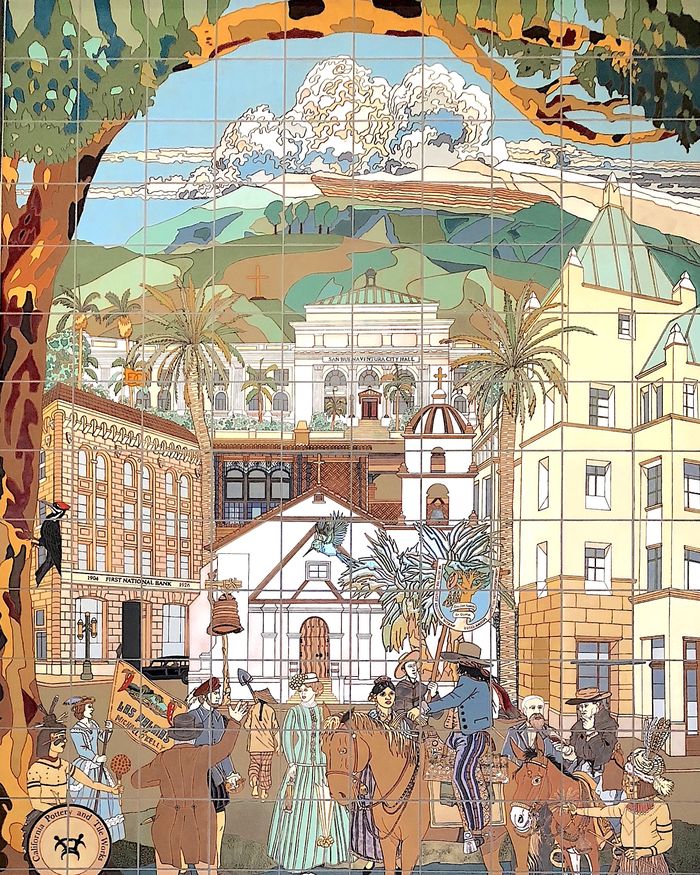
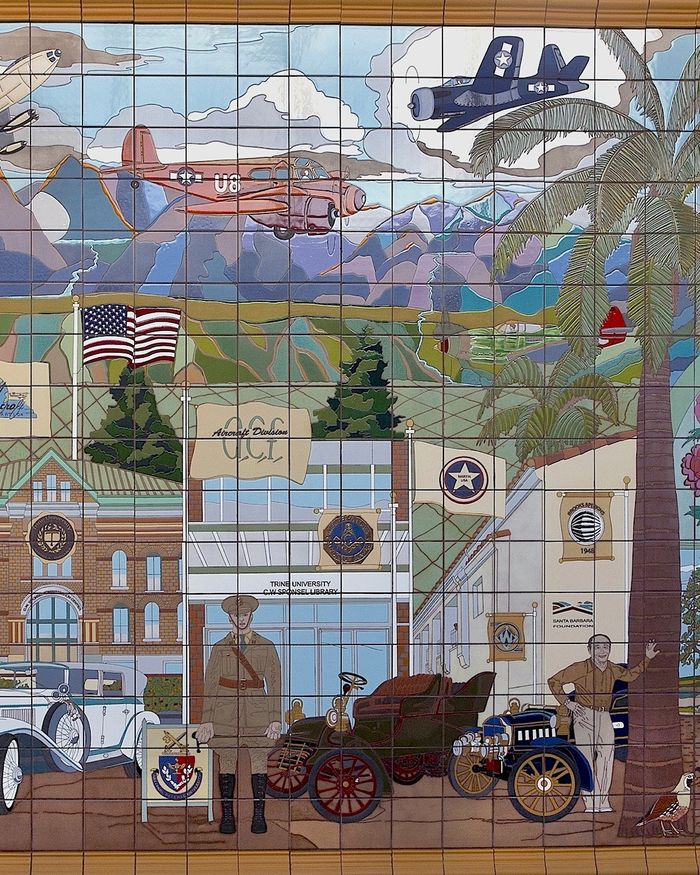
The wall opens where Ventura did: the Mission of San Buenaventura, founded in 1782, on land the Chumash called Shisholop — their word for the wetlands, bog and estuaries this all once was. Around it, the Mission bell, longhorn cattle, a vaquero, dancers, and a painter on a scaffold at work on the Mission itself.
1866: a city
The town incorporates. Victorian courthouses and houses rise behind the great fig tree that still stands by the post office; the railroad arrives from Los Angeles; the first fire company gets its engine. A Chinese woman beside the train stands for the Chinese quarter that grew up near the tracks. Nearby are a congressman, William Vandever, and Teddy Roosevelt, who visited around 1906.
Oil, orchards and the Star
Derricks crowd the hills: for a few years, Michael says, this was the biggest oil-producing place in America. Medallions of apricots, lemons, avocados and strawberries float above, with a grizzly and a mountain lion. Below them, the doctors, investors and newspapermen who made the town grow, one of them holding up the Ventura County Star.
The pier and the people
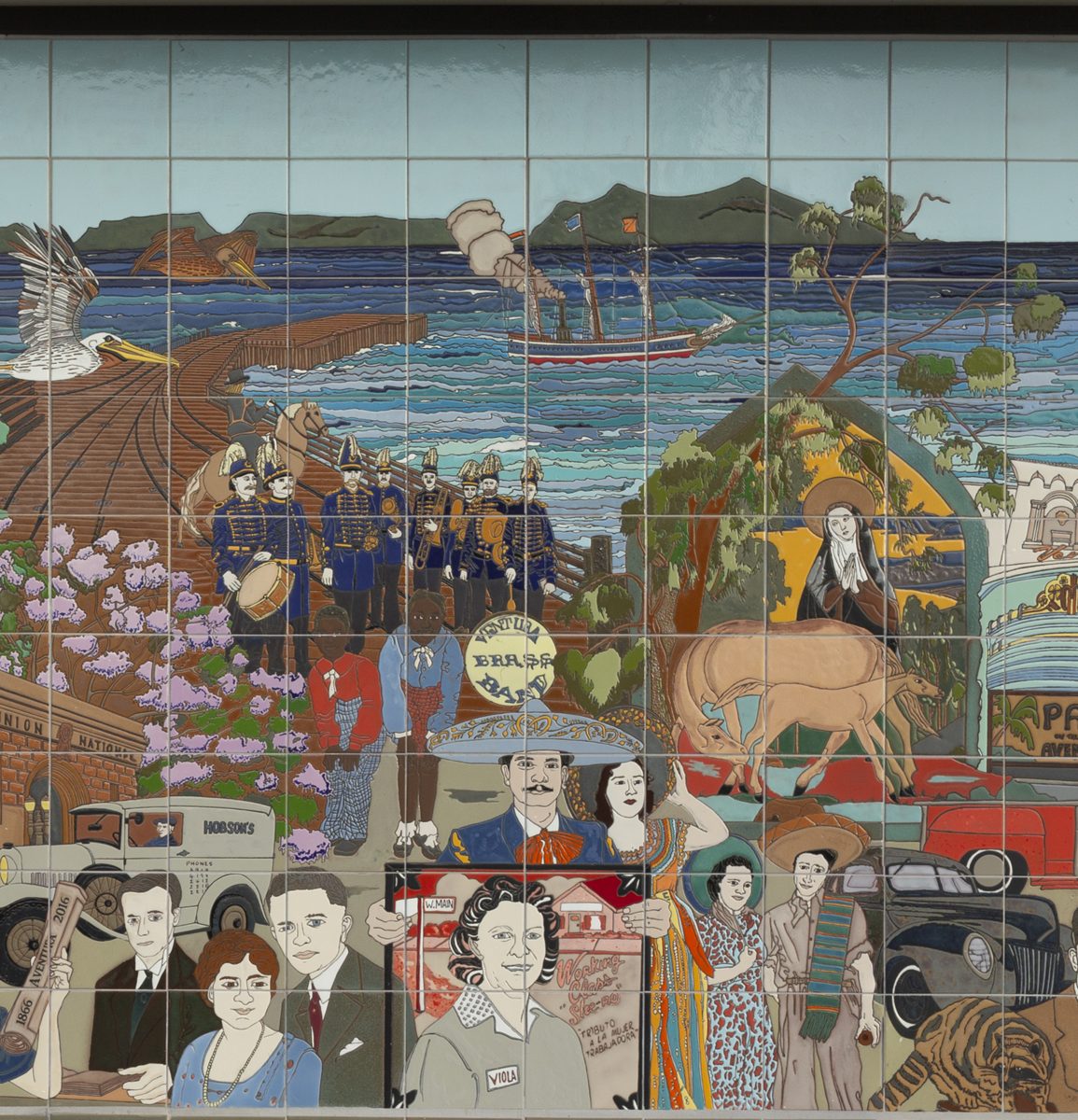
The long wharf, with rails running to the end, where steamers loaded oil and produce for San Francisco; the Ventura Brass Band; and the Mexican community of Tortilla Flats, at the end of the street, later erased by the freeway. Michael doesn’t soften it: “The Chinese kind of got pushed out, and the Mexican community was kind of dissipated… It wasn’t easy.” At the centre, a “Working Class Shero”: a tribute to working women.
Downtown and the surf
Mid-century Ventura: Tony’s Pizzaria, the Top Hat, Merle’s drive-in and the ballroom sign; a woodie with boards on the roof and a painted VW bus; the break at the point, a seal, and a whale off the islands.
Arts and culture
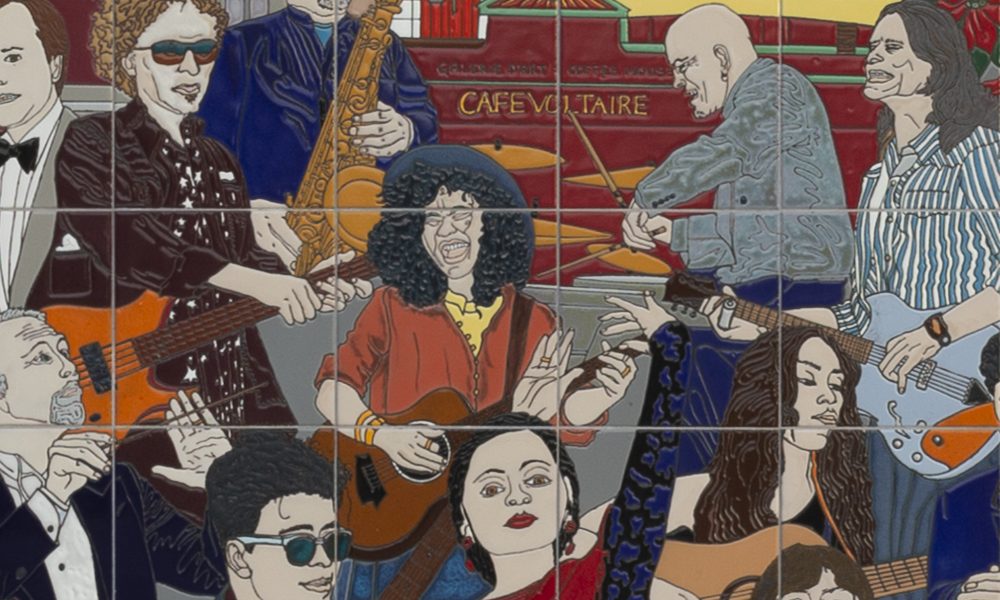
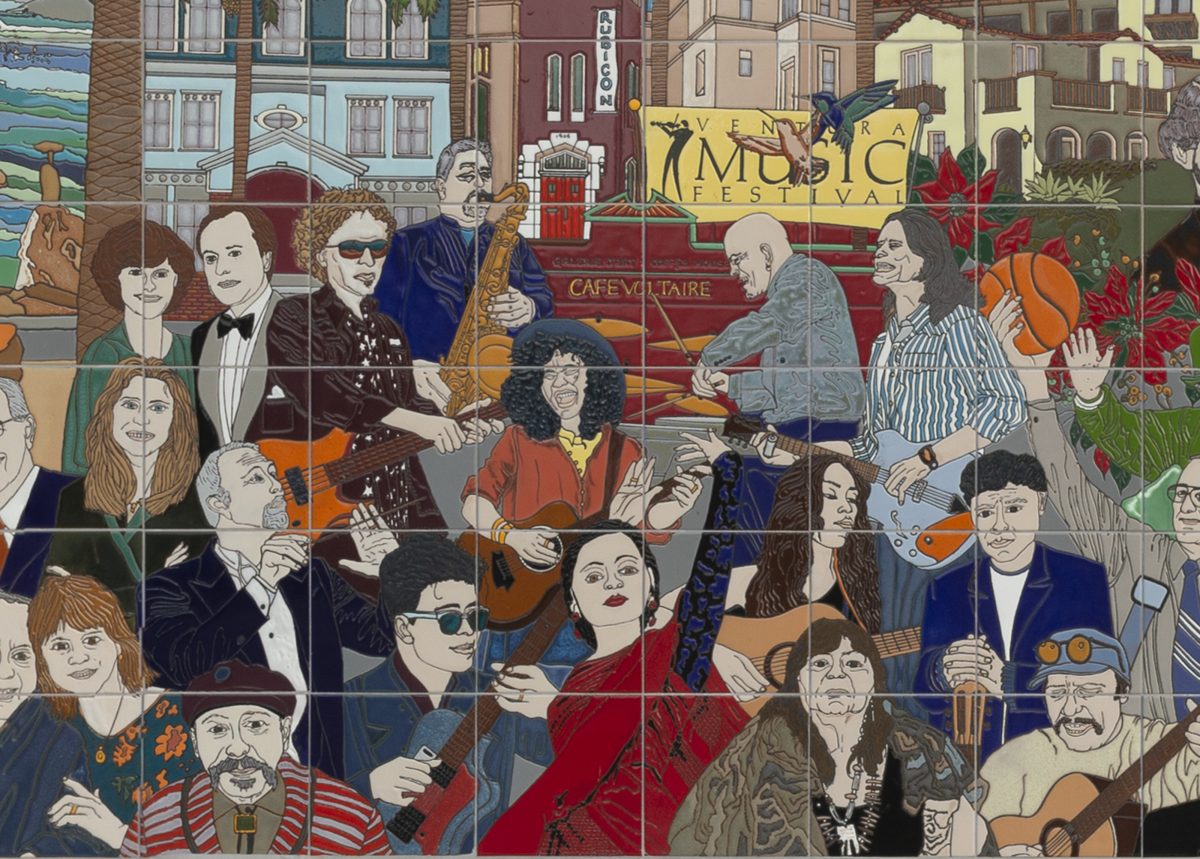
The Museum of Ventura County, the art association and film society, balanced-rock sculptures on the beach, the Rubicon Theatre, the music festival and Café Voltaire — and the town’s musicians, among them Nick St. Nicholas, a founding member and bassist of Steppenwolf, at the centre of the band with his bass, and the McEwan family.
2017: Ventura Strong
The ending he redrew after the Thomas Fire: present-day Venturans among poinsettias, firefighters, a phoenix rising, and a painter at work on “San Buenaventura 1782” — the wall ends as it began.
Just for fun
The music festival, come alive
What if the tile could play? This is the music festival stretch of the wall, animated. In the middle, on bass, is Nick St. Nicholas, a founding member and bassist of Steppenwolf in the late 1960s, and one of the Ventura musicians Michael put on the wall.
An AI animation made with Grok Imagine from a photograph of the mural. The mural itself is fired tile, and stays perfectly still.
December 2017
The ending he had to redraw
Five feet of the ending were already designed when the Thomas Fire came over the hills above Ventura in December 2017. About five hundred homes were lost, most of them on the hillsides; the town itself was saved by the firefighters.
One of them did not come home. Cal Fire Engineer Cory Iverson died fighting the fire near Fillmore, and a plaque in his memory now sits with the mural.
“This last part is new. I had to quickly redesign it, redraw it and make the ending. Ventura Strong — and the phoenix rising from the ashes.”
Michael O’Kelly, at the wall
Afterwards the fire department came to his studio to thank him. “They were really moved,” he says, “by the fact that we honoured them.”
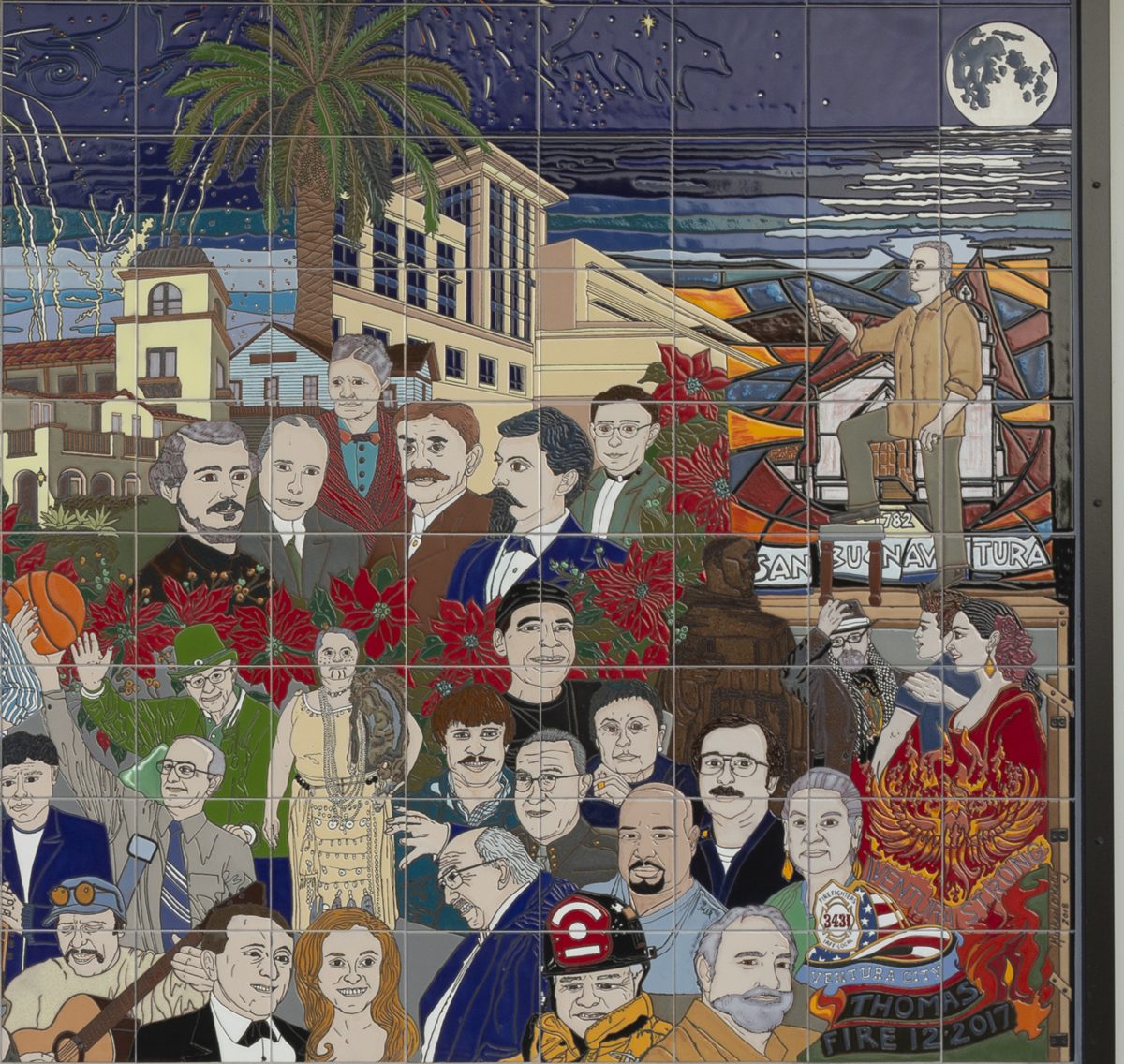
How it was made
From a spreadsheet to the sidewalk
“This mural was a big experiment,” Michael says. It took a year to draw and longer to glaze, and it was built to outlast everyone on it.
The historian’s list
Historian Cynthia Thompson gave Michael a spreadsheet of the people, buildings, places and dates the wall had to hold, starting in 1866.
A 25-foot drawing
A year of drawing, one person at a time, from photographs in the museum and in books: “a composition that makes sense as a work of art as well as a story.”
Glaze experiments
Metallic glazes mixed with ordinary ones, fired and refired, over about a year and a half.
Laid out next door
Finished tiles were laid out in the building beside the Mission to be checked; any that broke were made again.
A wall that won’t move
Rebar in every block, footings six to seven feet deep, and a new sidewalk. “If it moves in an earthquake, the whole thing will move.”
Four people, one canopy
Four people set the tile under a canopy built to keep off the sun. Installation took about three months.
Who paid for it
A wall its sponsors built
No city budget paid for this wall. It was raised from the people of Ventura, through the nonprofit Urban Encore, with the Ventura County Star among the sponsors.
Every sponsor of $1,000 or more is named on the tile plaques that run beneath the mural. Those who gave $15,000 or more could add an image to the story — which is why so many of the faces are somebody’s parent or grandparent.
“A lot of people who are alive today have relatives here who’ve passed on,” Michael says, “so it has an emotional connection to the people of the town.”
Ventura Police Department sergeant, killed on duty in 1978, is among the faces on the wall.
Remembered with a plaque at the end of the mural (see above).
The owner’s father, a Second World War veteran, is on the wall.
Press & recognition
What was written about it
- 2 Jan 2016Unique project to capture Ventura’s first 150 years
Ventura County Star, editorial — backing the legacy mural before a tile was made, and calling O’Kelly “the perfect choice for this visionary task.”
- 2018Mural celebrates Ventura’s more than 150 years as a city
Local press — the unveiling, with Mayor Christy Weir on the historical research behind it.
“Art is one thing, but historical accuracy is crucial.”
“My hope is that families will come here and see their family history. Children come to the Mission and look at the history of our city.”
Murals · building facades · fountains · bronze
Thinking about a wall of your own?
A town’s history, a company’s story, a family’s. Michael starts every commission the same way: a conversation about the place, the people in it and what the wall should say. Then a drawing.
See it
Visiting the mural
Where exactly
On Main Street, against the Mission’s Parish Center, under a shallow canopy. The sponsor plaques run along the plinth beneath it.
Access
Outdoors and free, day and night. It is a busy sidewalk, so step back to the kerb to take in the whole fifty feet.
Nearby
The Mission, the Museum of Ventura County, and Las Palmas at 60 California Street, a few minutes’ walk away. Main Street building facades →
Commissions
Commission a mural for your town
Civic, commercial and private work throughout California — researched, drawn by hand at full size, and glazed to last longer than any of us.
Related work
More of Ventura, in tile
 Scroll or pinch to zoom · drag to pan · Esc to close