How to look closely
- Click the mural to open it full-screen at full resolution.
- Scroll or pinch to zoom in and out. Drag to move around the wall.
- Double-click to jump in a step; the Fit button brings the whole mural back.
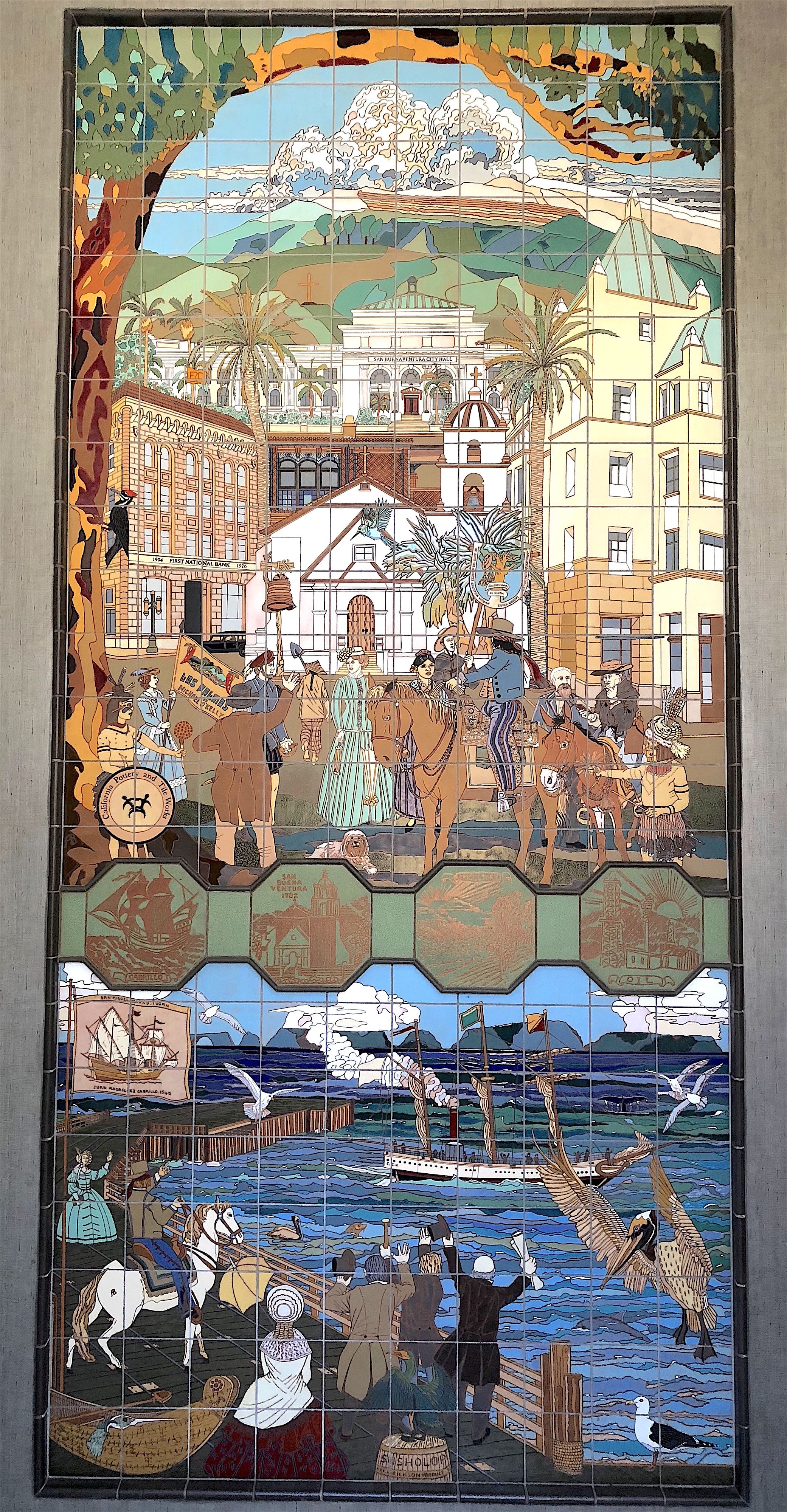
- The numbered markers — 1 to 4 — go straight to a detail worth finding. Find all four — they match the cards just below.
- Esc closes the viewer.
Ceramic tile mural · Ventura, California · 2009
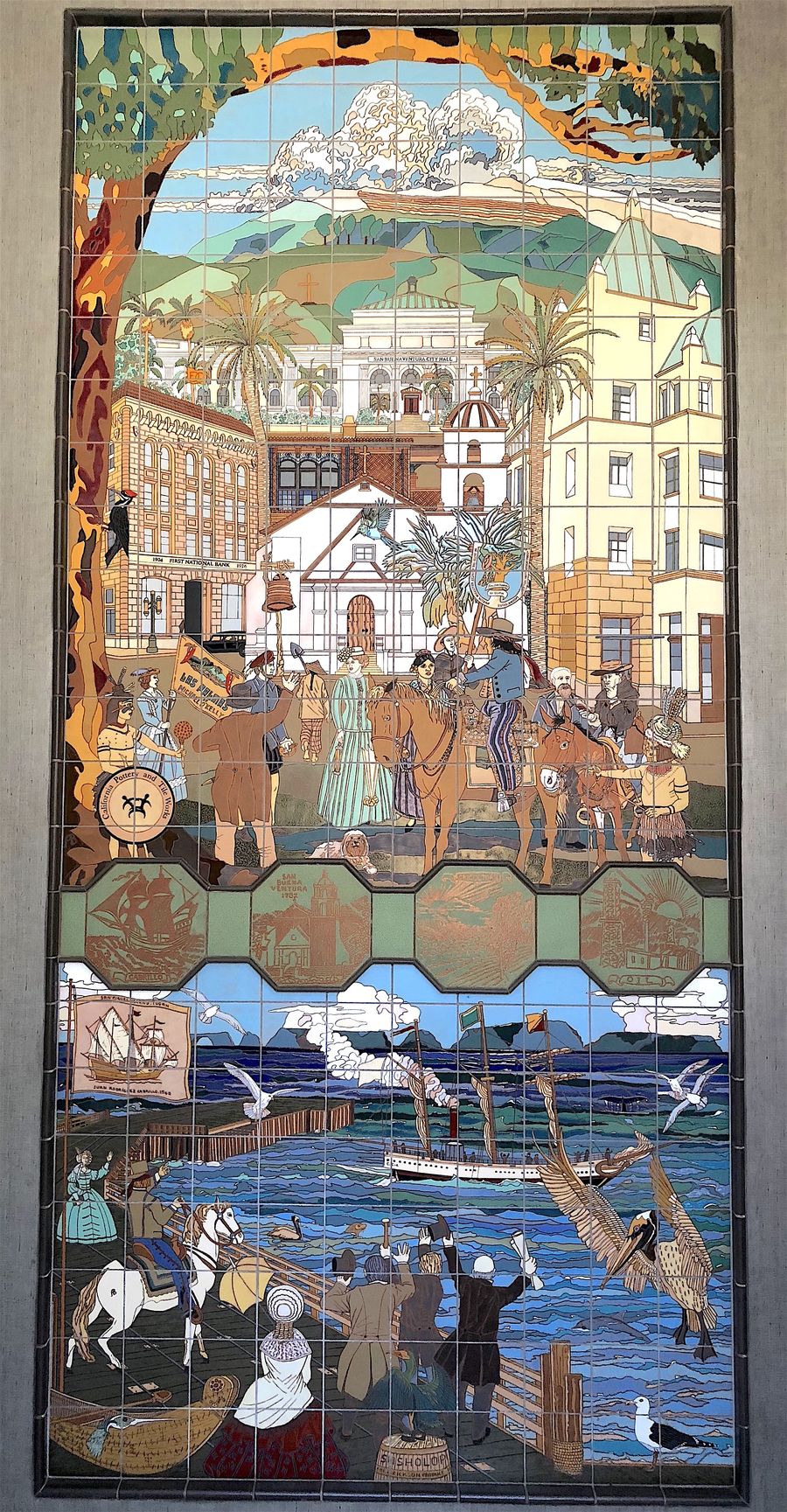
Las Palmas
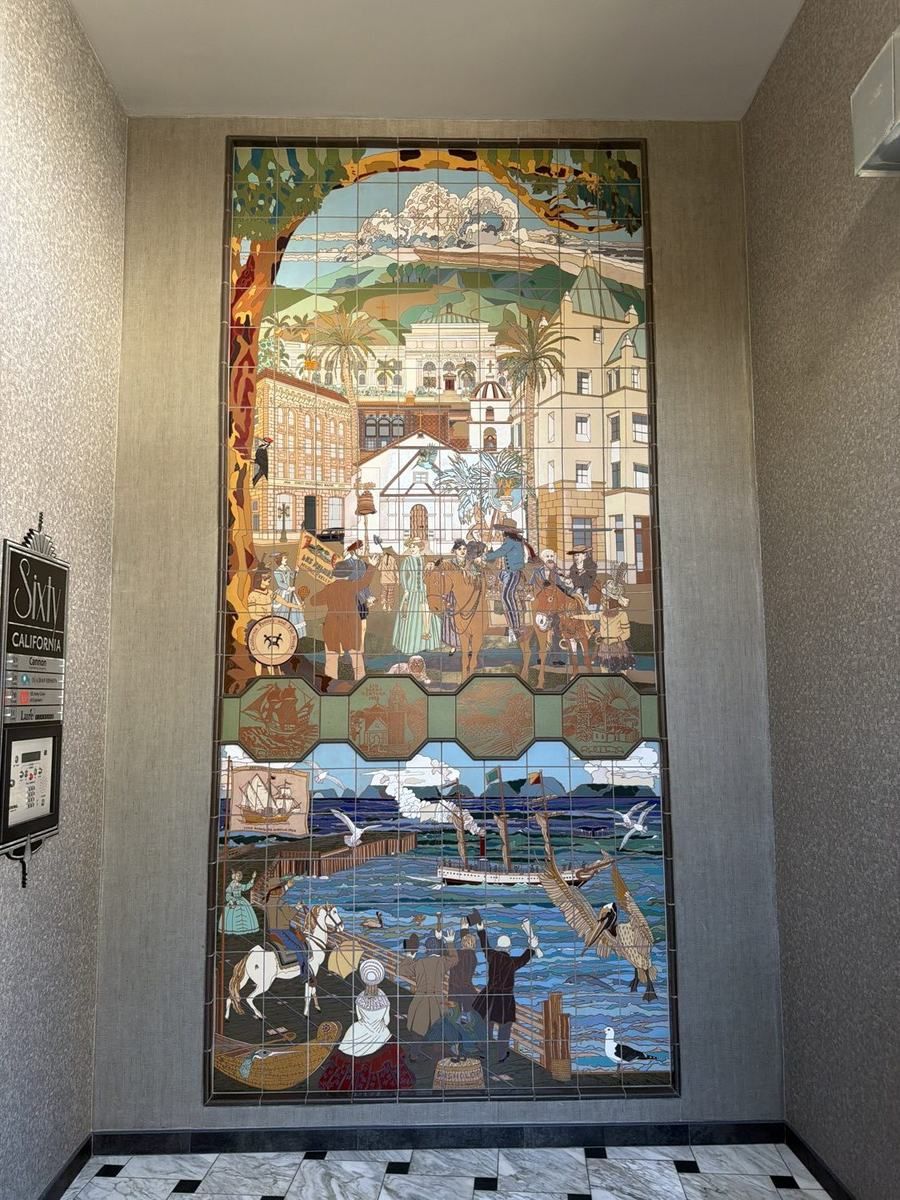
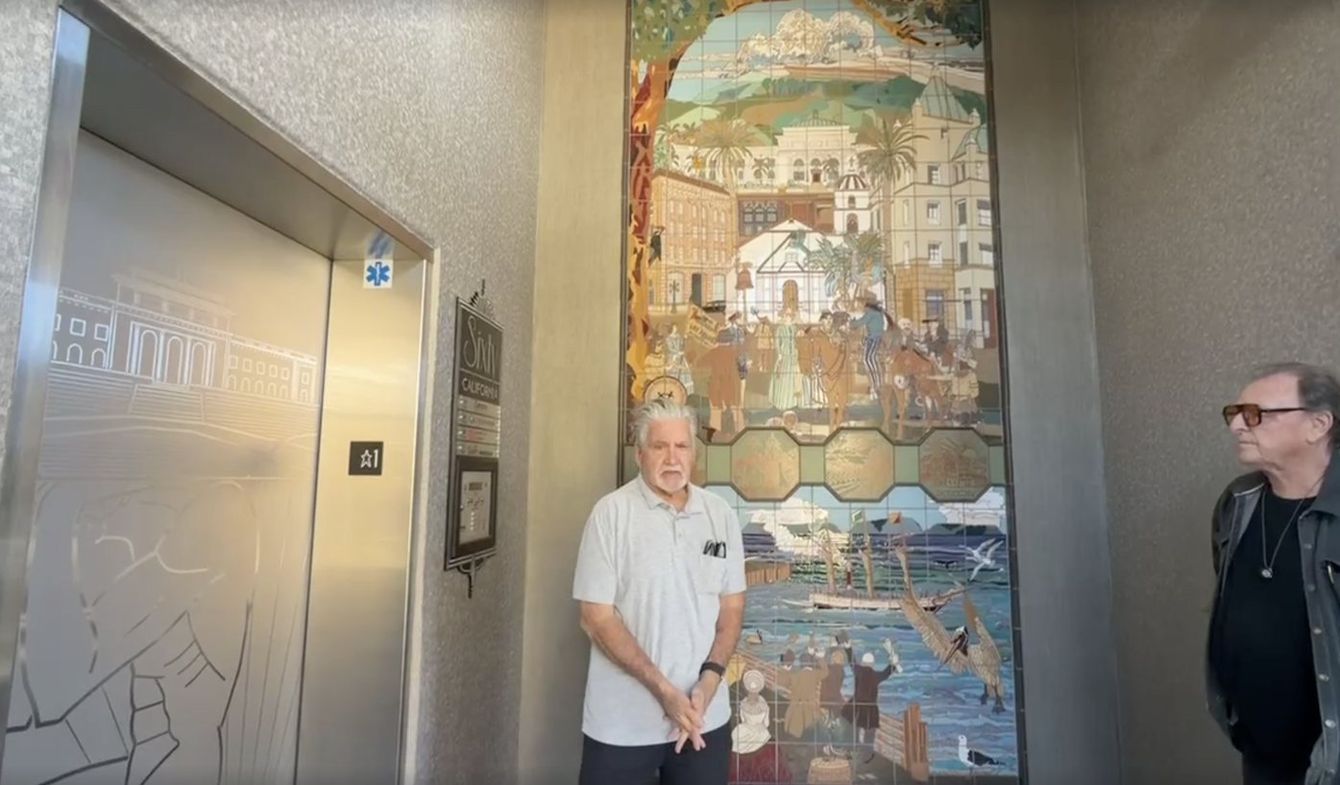
The history of a town, glazed into the lobby wall at 60 California Street
Dan Frederickson asked for an entrance that could only be in Ventura. He got two centuries read from the top down — and, hidden in it, his dog, his wife’s name and his favourite novel.
- Year
- 2009
- Medium
- Hand-glazed ceramic tile on terra cotta
- Technique
- Cuerda seca, 40-colour glaze
- Dimensions
- Approx. 13 × 5 ft
- Commissioned by
- Dan Frederickson
- Made in
- Ventura, California
- Location
- 60 California St, Ventura CA
- Access
- Entry lobby, business hours
Film
Michael and Dan at the mural
Four minutes in the lobby with the artist and the man who commissioned him, walking the wall detail by detail.
Las Palmas · 60 California Street
Michael O’Kelly
michaelokelly.com
Read the transcript
Dan Frederickson“My name is Dan Frederickson, and I built a building in Ventura, California several years ago down on California Street. The idea behind that building at the time was to kind of consolidate the Art Deco work in downtown Ventura with some of the other architecture — and I think that our architect did that. It’s a beautiful building. And as part of that, we had the opportunity to see Michael. One of the best tile people I think I’ve ever worked with … to do an entryway for us in this office building. This is it here.”
“The thing I like about Michael’s work is the professionalism of it, but also the custom aspect. And he’s very, very creative. And he also works with you to customise the type of thing you might want for yourself. So — in keeping with this building, Michael brought together the characteristics of downtown on the tile structure itself, but we also had some fun things. My dog was in it — she has since passed, but she’s right here, she was included. And then he named the boat after my wife. It’s a wonderful history of the town. It shows the Mission up in the centre. Michael, do you want to talk about some of the other aspects of it?”
Michael O’Kelly“I picked four or five buildings that stood out, in my mind, architecturally — Dan’s building, Sears on the right, the City Hall, the Mission, the Watermark and the First National Bank. I thought those were the sort of modern twentieth-century history buildings that were most significant. And then just periods that you match: the Spanish, the pier — the pier which had the railroad on it, with the boxcars to come down and pick up the stuff from Ventura County. And the original name, before the Spanish…”
“I just wanted to give us some character. It’s not an attempt to tell our entire history; it’s just to be colourful and attractive, and make people feel interested in being in Ventura, really.”
Dan Frederickson“But for commercial businesses, for office buildings and things like that — I think that you can make a statement, his company can make a statement for you, that reflects what’s going on in your community that you’re serving, and the type of how you want your business to be represented. This is a Class A office building. I also focused on custom work here. This is an etching of Ayn Rand’s book Atlas Shrugged, because I’m a conservative business person … And also — it’s beautiful.”
Michael O’Kelly“Should I tell them the woodpecker story? … There’s a woodpecker, which I liked, and that’s why I put it in. Everything is from Ventura. So when Dan asked me to be here — the members of an Art Walk, and it had just been unveiled, so you wanted me to be here to talk to people. People were coming in and out. About twenty-five people in this room, looking at it. And I was telling him, and trying to say that it’s historical, it’s all true and everything. Then this guy came in, a tall guy, and he shouted across everything that that woodpecker is not from Ventura — that everything’s true, so… Everybody looks, turns around at me, tries to see if I’m going to respond. And I said: well, you see that guy down there? He’s from San Francisco, he’s an architect. He just came down from San Francisco on that boat and he’s saying goodbye to his friends. That was his pet woodpecker, and it escaped. And everybody started laughing, and the guy walked off in a huff. So you’ve got to be on your feet when you’re an artist, okay?”
Transcript lightly edited for readability.
Find it in the mural
Four things hidden in the tile
Every O’Kelly commission carries pieces of the person who paid for it. Find all four: tap a card, or a numbered marker on the mural at the top of the page, and the viewer flies straight to it at full magnification.
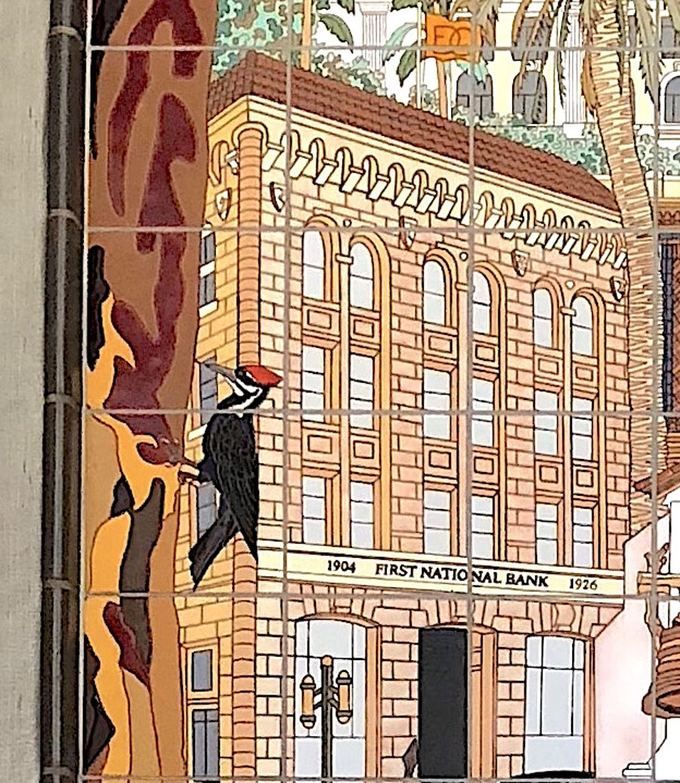
1The woodpecker
A pileated woodpecker on the trunk beside the First National Bank — put there because O’Kelly liked it. It has caused the only argument this mural has ever started.
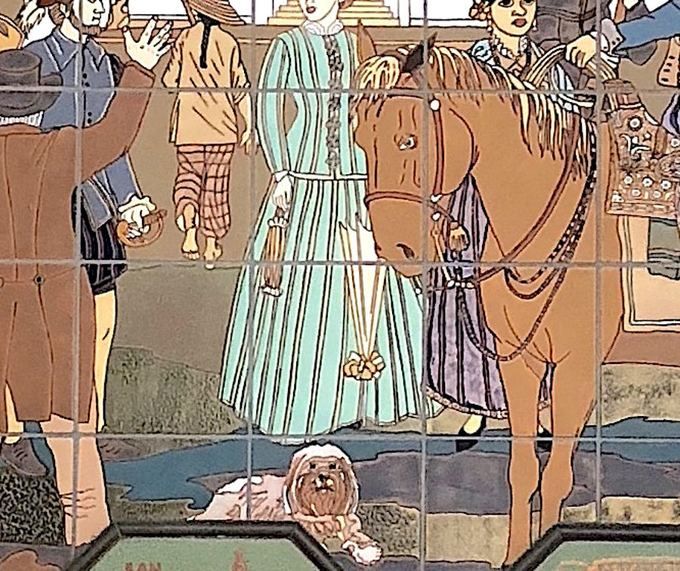
2The dog
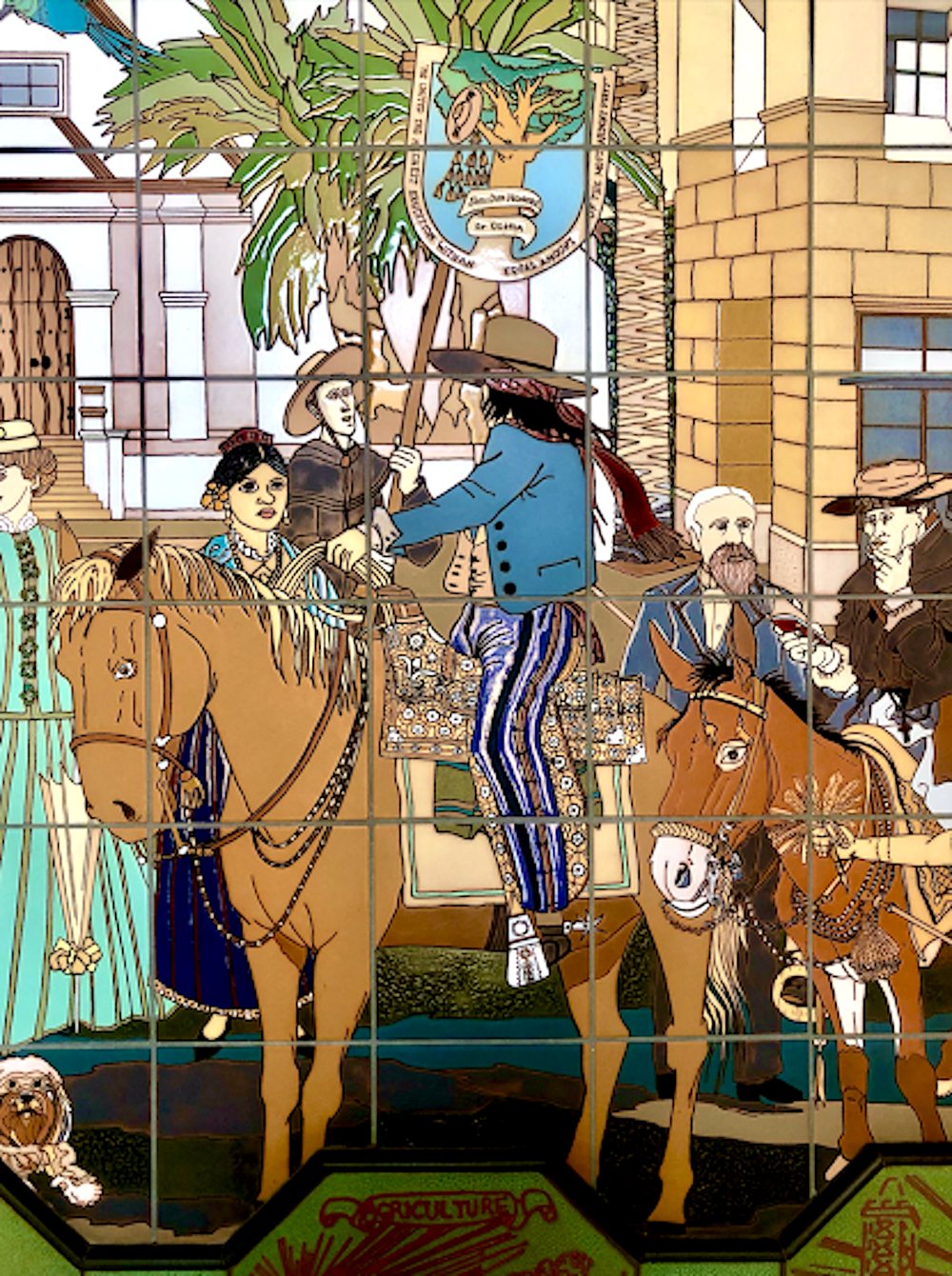
Frederickson’s dog is in the crowd, at the feet of the horses, looking out at whoever is looking in. She has since died; she is still on the wall.
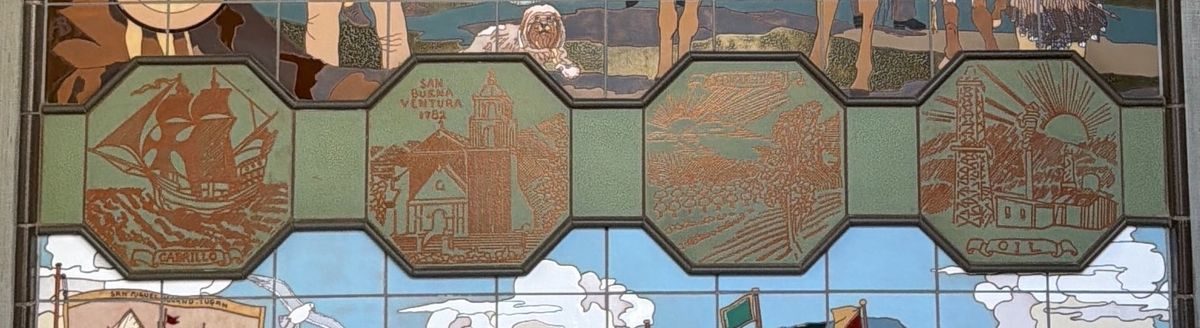
3The medallions
Four plaques in oxide green, borrowed from the bronze doors of Ventura City Hall: Cabrillo, the Mission, agriculture and oil — the industries that carried the county.
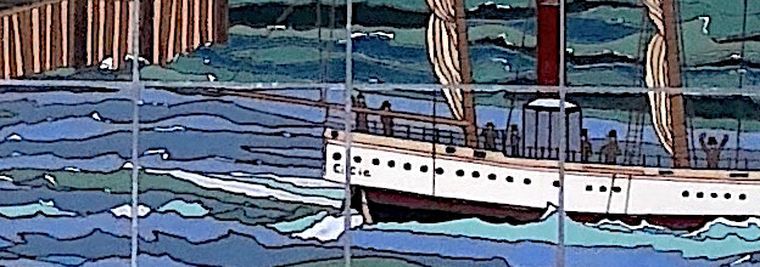
4The steamer’s name
The steamer working the wharf is named for Frederickson’s wife — lettered small on the bow, where only someone who knows to look will find it.
Reading the mural
Three registers, top to bottom
The mural is built as a vertical sequence. The eye enters at the top, in the street; drops through a band of civic emblems; and lands at the water, where the town began.
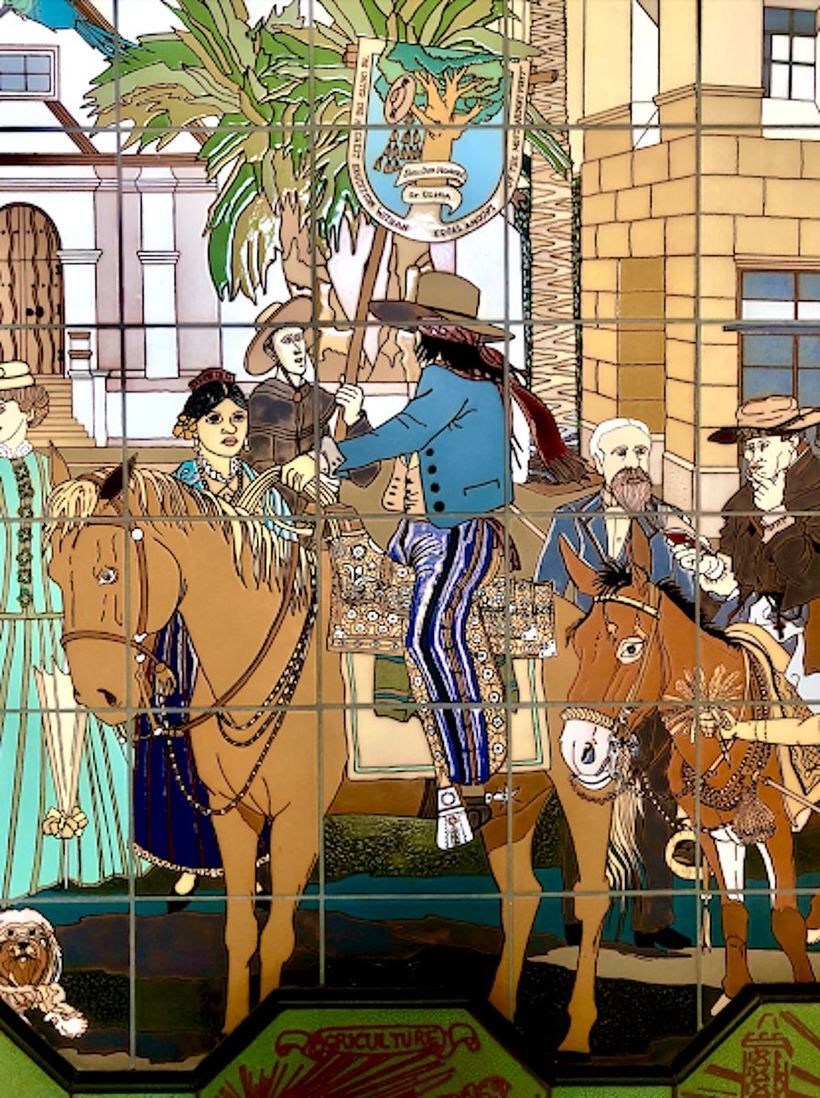
The town assembles
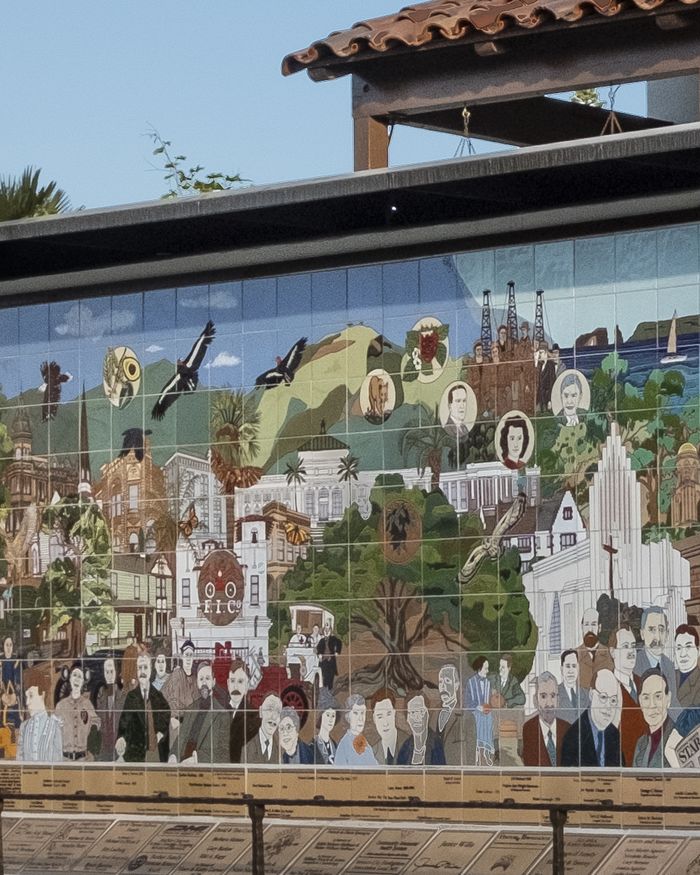
A street gathering in front of the buildings O’Kelly judged most significant, with the Topa Topa mountains and a bank of cumulus closing the top of the arch. The figures come from period photographs — the clothing, the saddles and the tack are researched, not invented.
- First National BankDated 1904 and 1926 on its own cornice band; still standing at California and Main.
- San Buenaventura MissionThe white building facade and bell at centre left.
- Ventura City HallThe domed civic building above the rooftops.
- The Groene BuildingThe 1920s block now occupied by the Watermark on Main.
- 60 California StreetFrederickson’s own building, written into the skyline it belongs to.
Four medallions in oxide green
A row of octagonal plaques divides the mural and cools it. The device is borrowed from the bronze doors of Ventura City Hall, and each medallion stands for one of the industries that carried the county.
- CabrilloHis ship under sail, named on the scroll beneath — landfall on San Miguel Island, Toqan to the Chumash.
- MissionThe San Buenaventura Mission, inscribed San Buena Ventura 1782.
- AgricultureOrchards and row crops running back to the hills — the valley that fed the wharf.
- OilA derrick against a rising sunburst, lettered OIL — the industry taking off as the wharf below was working.
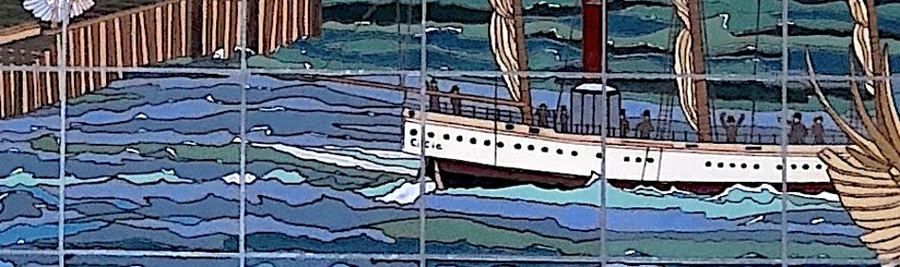
The wharf
Everything used to arrive here. O’Kelly gives the bottom third of the mural to the water: the long timber pier that carried a railroad out over the surf so boxcars could run down and collect the county’s produce, and the coastal steamer standing off it.
- The pierRail tracks ran the length of it; freight was worked from the deck.
- The crowdHats raised on the pier head — an arrival, not a departure.
- WildlifeBrown pelicans, gulls and a whale on the horizon, all resident here.
- ShisholopThe Chumash name for this place, before the Spanish one.
From the unveiling
The woodpecker argument
The mural was unveiled during a downtown Art Walk. O’Kelly was in the lobby at Frederickson’s request, with about twenty-five people in the room, explaining that the mural was historical — that everything in it was true, and everything in it was from Ventura.
A tall man at the back shouted across the room that the woodpecker is not from Ventura.
Everyone turned to see whether the artist would answer. He did.
“You see that guy down there? He’s an architect. He just came down from San Francisco on that boat, and he’s saying goodbye to his friends. That was his pet woodpecker — and it escaped.”
Michael O’Kelly, at the unveiling
The room laughed. The man walked off in a huff. “So you’ve got to be on your feet when you’re an artist,” O’Kelly says.
How it was made
Every figure on this wall was drawn by hand first
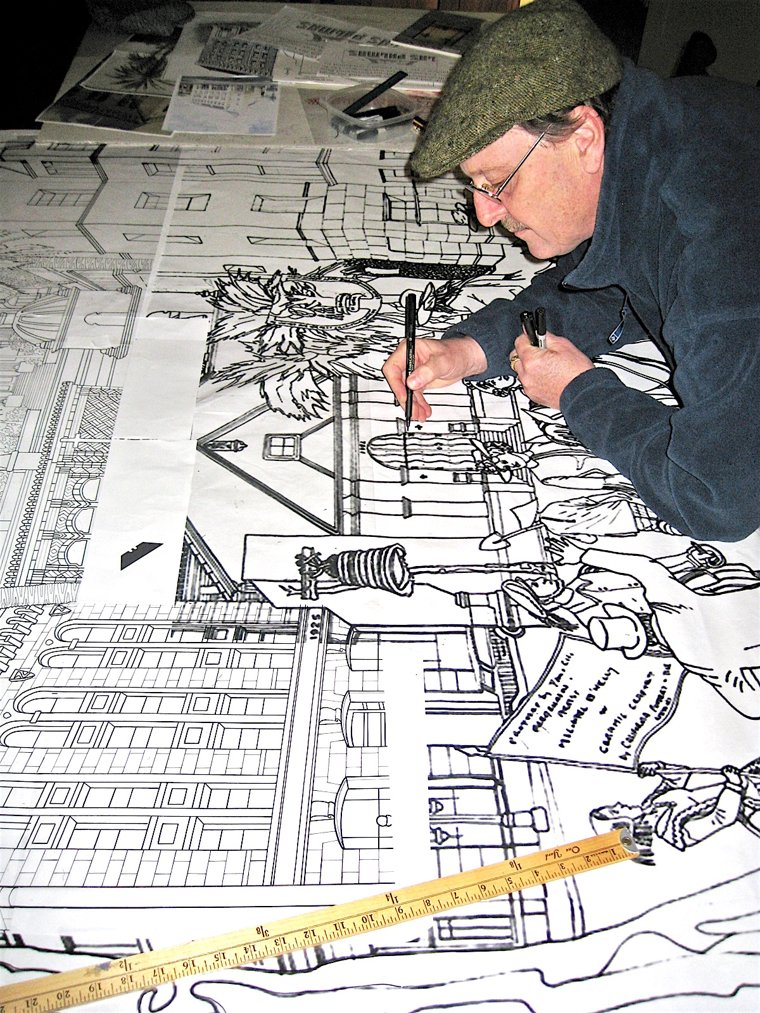
Before a single tile was fired, O’Kelly drew all thirteen feet of Las Palmas in pen and ink, at full size. Keep scrolling and the wall moves past you, top to bottom, the way he drew it.
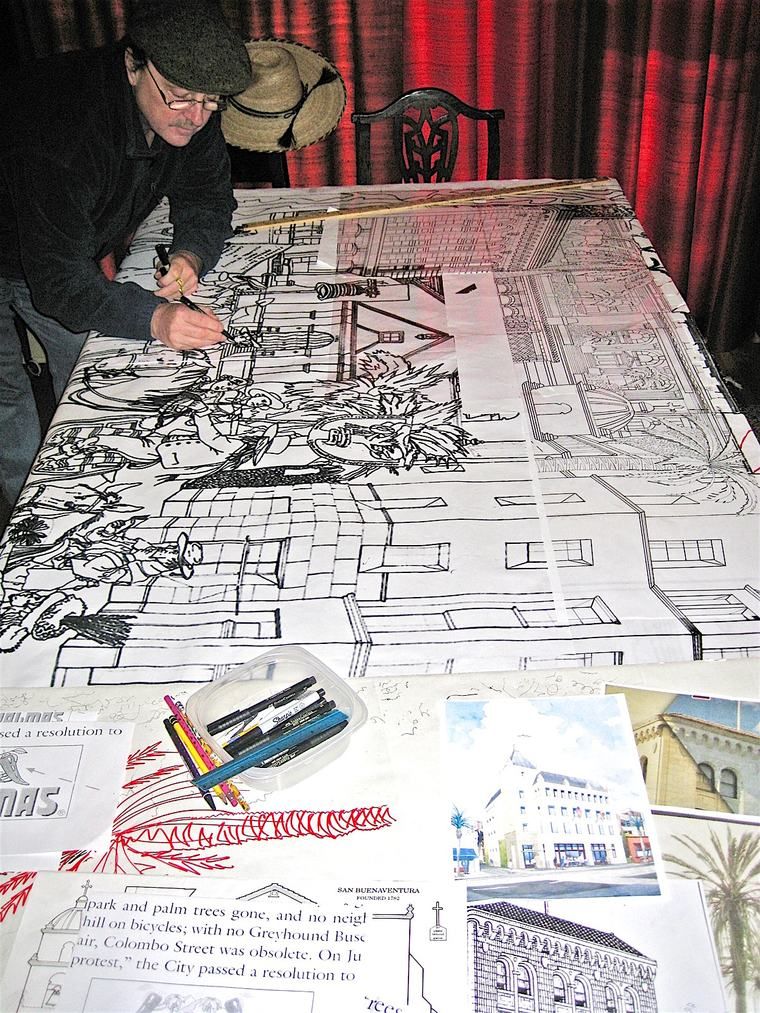
Pen and ink, then fire
Six steps from drawing to wall
O’Kelly works in cuerda seca — “dry cord” — a Persian technique of the ninth century that reached California by way of Spain and became the language of Spanish Revival tile. Unglazed resist lines hold each colour in its own field, so the glaze pools and the surface reads slightly raised, like a leaded window.
Research
Weeks in the Museum of Ventura County library. Saddles, canoes, clothing and building dates are checked against the record before a line is drawn.
Pen-and-ink drawing
The whole composition is drawn by hand at small scale, then enlarged to the mural’s exact finished size.
Traced to acetate
The full-size cartoon is traced onto acetate and separated into tile-sized units.
Screened onto terra cotta
A silk screen is burned from the acetate and the line is printed directly onto the raw clay. “Like making a T-shirt,” O’Kelly says.
Glazed to a colour sheet
The tiles go to the glazers with a painted sheet of forty colours to follow, each glaze laid inside its resist line.
Fired and set
Fired, then set tile by tile on the wall by the artist.
Twenty-two colours sampled from the surface — the glazers worked to a painted sheet of forty
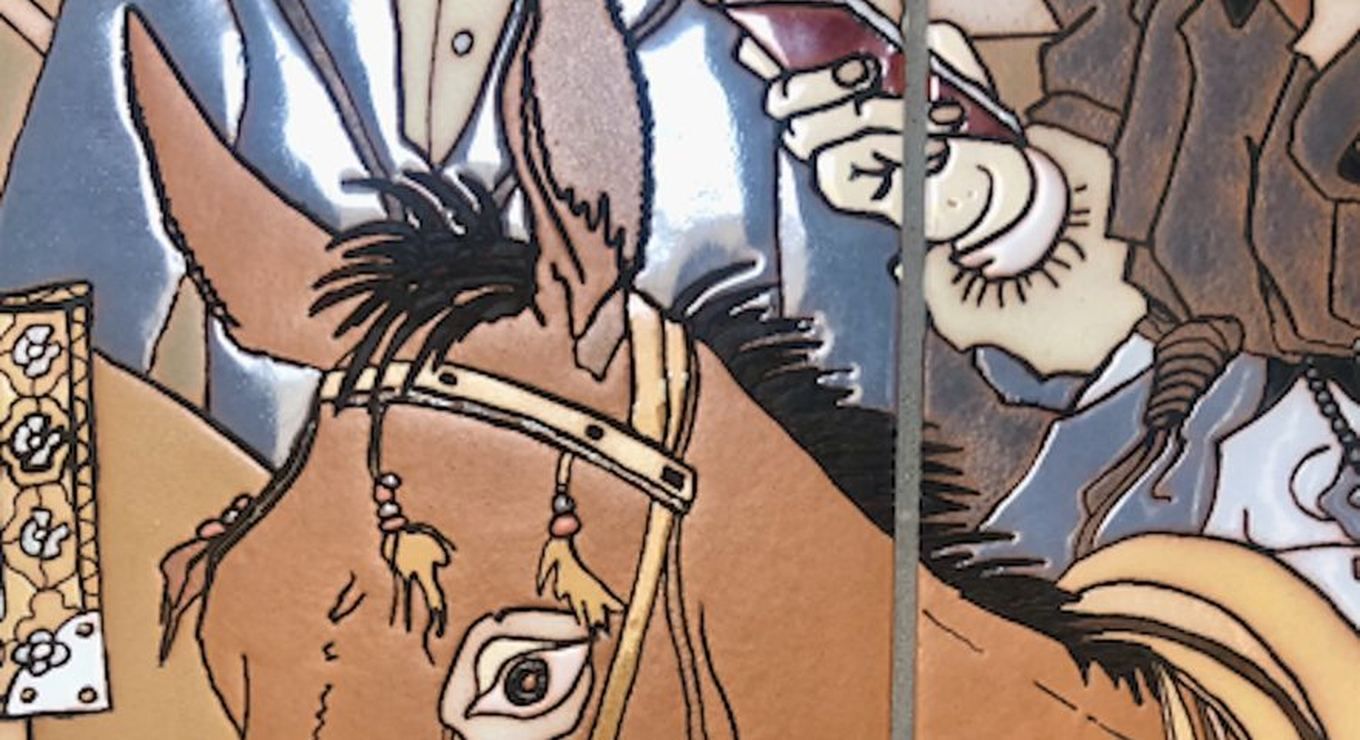
Why an O’Kelly wall glows like stained glass
- Forty glaze coloursEach one laid by hand inside its own raised line, so colours never bleed into each other.
- A line you can see and feelThe unglazed resist stands slightly proud of the glaze, so the hand-drawn line survives the kiln as part of the surface.
- A ninth-century techniqueCuerda seca came from Persia by way of Spain. It is why the mural reads like a leaded window from across the lobby.
Press & recognition
What was written about it
- 24 Aug 2009Artist’s mural tells history of Ventura
Brenda Loree, Ventura County Star — the installation reported in detail, with O’Kelly’s account of the silk-screen-on-terra-cotta method and the research behind the imagery.
- 2009Beautify Ventura Award
60 California Street recognised by the City of Ventura, the mural cited among the building’s contributions to the downtown streetscape.
- 2015Mayor’s Arts Award — Artist in the Community
O’Kelly honoured at the eleventh annual Mayor’s Arts Awards, Museum of Ventura County.
Murals · building facades · fountains · bronze
Thinking about a wall of your own?
A lobby, a storefront, a whole building face, a theatre. O’Kelly starts every commission the same way: a conversation about the building, the people in it and what the wall should say. Then a drawing.
See it
Visiting Las Palmas
Where exactly
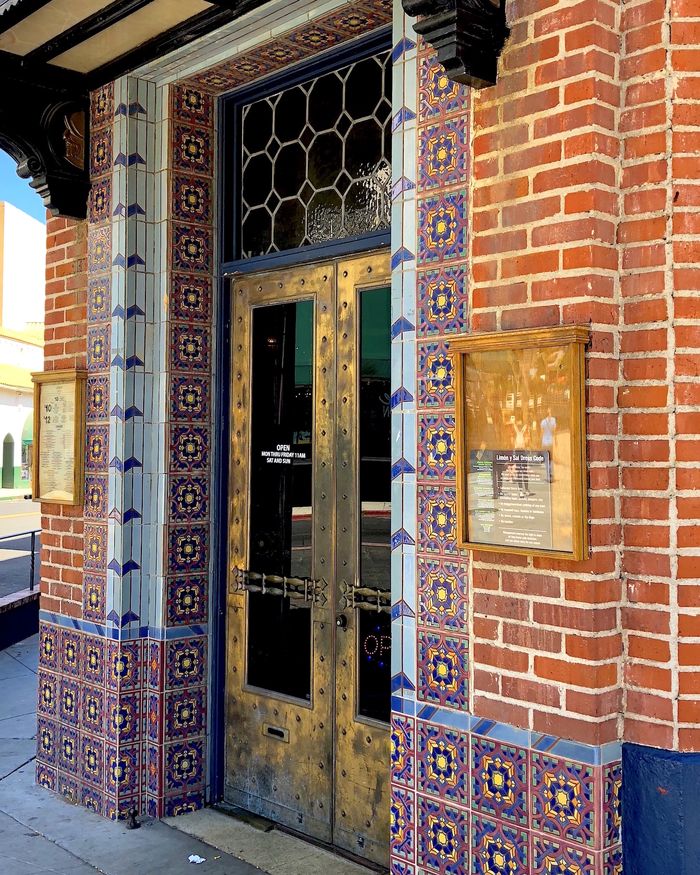
The entry lobby, immediately inside the California Street doors, on the left-hand wall. The plaque outside reads Sixty California.
Access
Free, during business hours. No appointment needed — but it is a working entrance, so let people through.
Nearby
The Main Street building facades and the Mission mural are a five-minute walk. See the downtown tile walk →
The commission
A building that wanted to make a difference
Sixty California Street was built to pull downtown Ventura’s Art Deco inheritance together with the architecture around it — a building meant to give something back to the street rather than simply fill a lot. Having gone that far, Frederickson wanted the entrance to finish the job.
O’Kelly’s brief to himself was narrower than a history lesson: not the whole story of the town, but enough of it to hold someone crossing a lobby. He chose four or five buildings that stood out to him architecturally — Frederickson’s own among them — and set them against the two eras that made the place: the Spanish period, and the wharf.
Then he worked the client into it. A dog at the feet of the crowd. A steamer named for a wife. None of it is announced; all of it is there.
He calls the result public-private art: privately paid for, permanently on public view, three steps off the sidewalk.
The building
Sixty California
A Class A office building on the corner of California and Santa Clara, three blocks from the pier the mural is about. Cast stone at the base, cream stucco above, and an Art Deco canopy over an iron gate worked in rising sunburst.
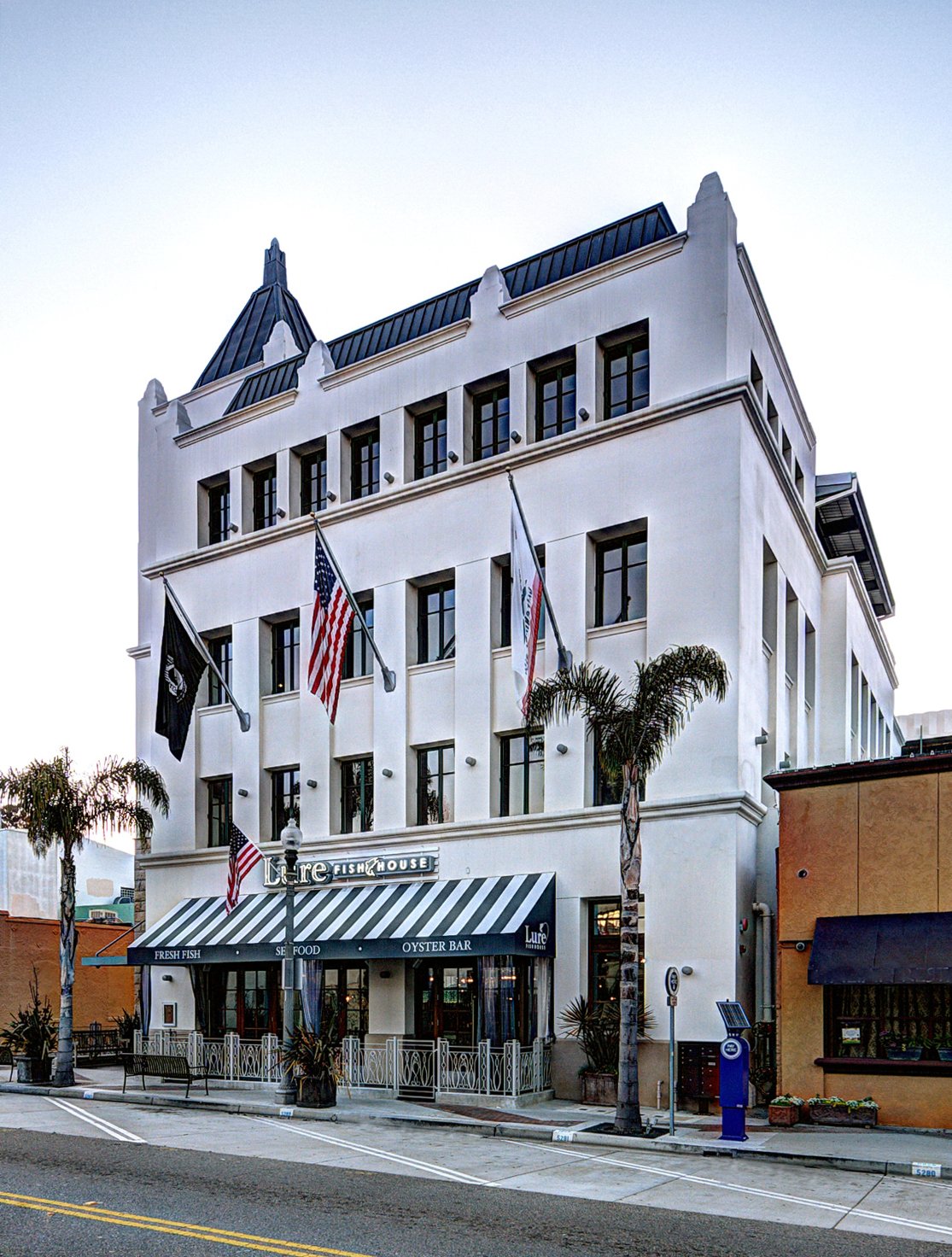
The exterior sets up the mural before you reach it. Rusticated cast stone, a stepped corner bay, the flat steel canopy and the fan motif in the ironwork all belong to the same downtown Deco vocabulary O’Kelly then quotes in glaze: the arch, the octagonal medallions, the hard geometry holding soft colour.
Inside, the mural runs floor to ceiling on the left wall of a small entry — not a gallery, a doorway people walk through on the way to work. That is the point of it.
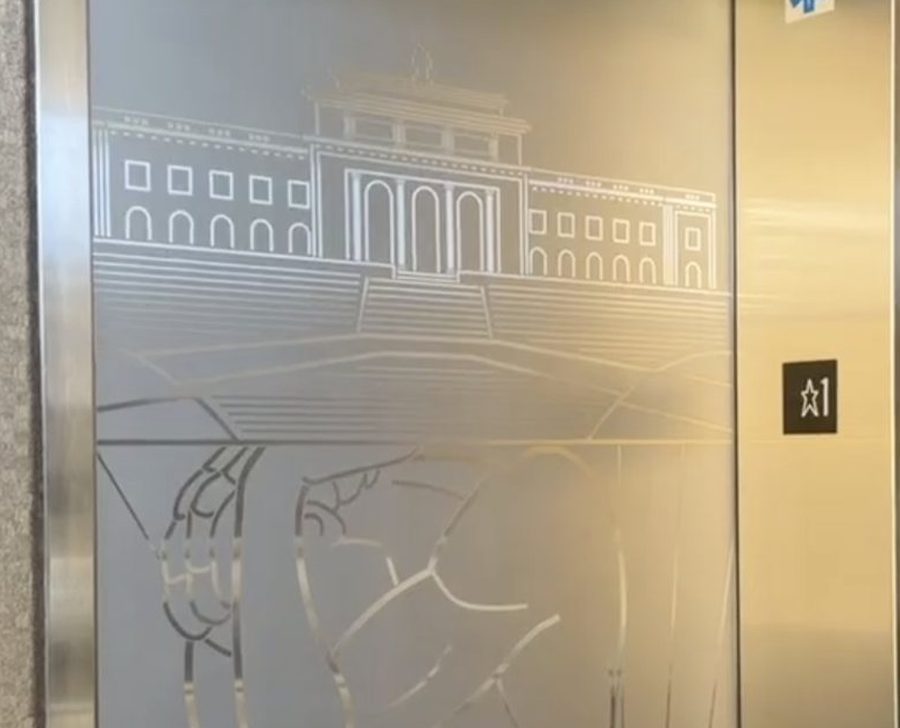
Across the lobby: Atlas Shrugged
Opposite the mural, Frederickson had a scene after Ayn Rand’s novel etched into the elevator doors — a colonnaded building above, Atlas stooped beneath it. It is not O’Kelly’s work, but it is part of the same idea: a lobby that says something about who built it.
“This is a Class A office building,” Frederickson says. “I also focused on custom work here.”
In the client’s words
Dan Frederickson on working with O’Kelly
“What I like about Michael’s work is the professionalism of it, but also the custom aspect. He’s very, very creative — and he works with you to customise the type of thing you might want for yourself.”
“For commercial businesses, for office buildings, I think you can make a statement that reflects what’s going on in the community you’re serving.”
Commissions
Commission a mural for your building
O’Kelly designs each commission with the client, in the studio, from the first pen-and-ink drawing to the last tile set on the wall. Residential, civic and commercial work throughout California.
Related work
Elsewhere in Ventura and Santa Barbara
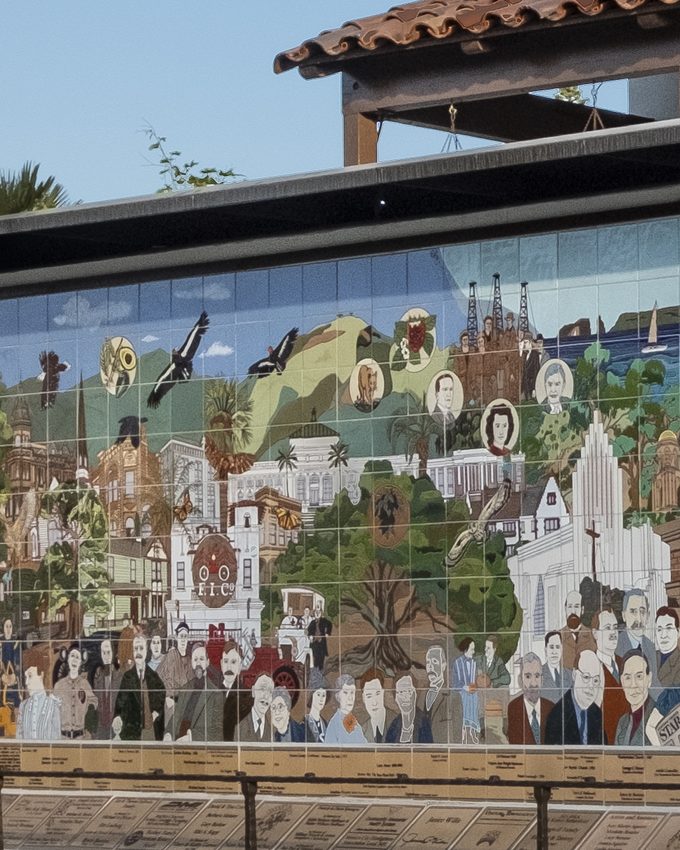
Ventura Historic Mural
Fifty feet beside the San Buenaventura Mission, made for the city’s 150th anniversary.
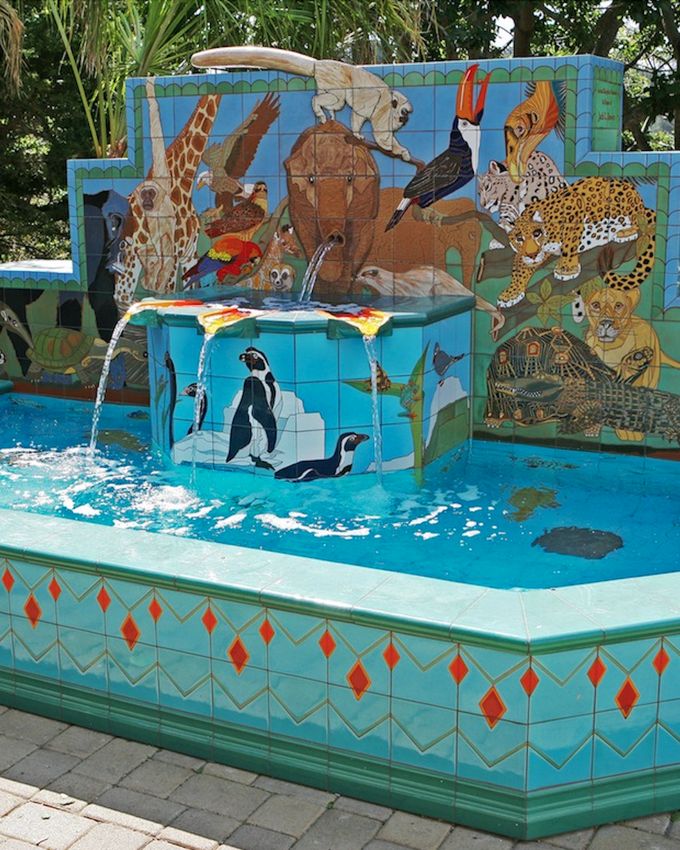
Animal Kingdom Fountain
Santa Barbara Zoo — a tiled fountain given in memory of Jack C. Bowen.
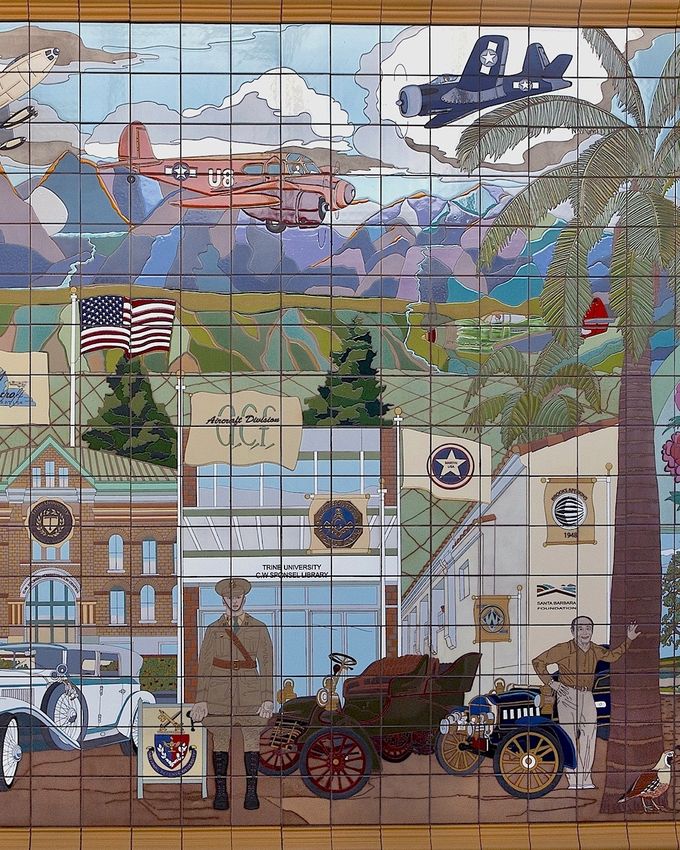
Giving Back
One hundred and sixty tiles telling the life of a Santa Barbara philanthropist at 102.
 Scroll or pinch to zoom · drag to pan · Esc to close